The $200/Month Ad Budget: Why Small Med Spa Ads Fail After the Click
At about $100 a lead, $200 a month buys two inquiries. Whether they're worth an estimated $3,000 each depends on a five-minute reply, a real price answer and a booked second visit.

Bill Eisenhauer
July 09, 2026 · 9 min read
A $200-a-month ad budget doesn’t fail because it’s small. It fails after the click. At roughly $100 per paid lead (the cost the example practice in The Med Spa Money Map pays), $200 buys about two inquiries a month. Answer both inside five minutes, give them a real starting price and book the second visit before the first one ends, and each patient who stays is worth an estimated $3,000 over the relationship. Let the inquiry sit until tomorrow or lead with a discount, and the same $200 buys nothing that lasts.
At a glance
- About two leads a month: at roughly $100 per paid lead, a $200 budget is a handful of inquiries a year, so every one has to be handled well
- 74% of practices miss the five-minute window for new inquiries, which is where most small budgets actually leak
- 73% of discount patients never return at full price, so a cheap intro offer buys first visits, not patients
- An estimated $12,000 in lifetime value a year separates a 30% consult close rate from 45% on just 24 paid leads
Key takeaways
- With a small budget, the ad isn’t the bottleneck. You’re paying for a few dozen inquiries a year. How fast and how well the practice answers them decides the return far more than the creative or the targeting.
- Speed decides whether the lead is still yours. Most aesthetic inquiries arrive after hours, and interest fades within the hour. An instant, specific reply holds the lead until a person can offer two times.
- Don’t buy patients with a discount you’ll have to keep giving. Lead with the treatment and a starting price range, not a deal. The deal-seeker costs the same $100 to acquire and rarely comes back at full price.
- Run this check this week: submit a test inquiry through your own ad’s form tonight after hours. Time the reply, and read whether it offers a bookable time or just says “we’ll be in touch.”
- Take the free diagnostic → It shows whether consult follow-up is where your ad money is leaking.
What does $200 a month actually buy a med spa?
Less than most owners picture, which is exactly why it has to be handled carefully. Take the book’s example practice, Lumen Aesthetics. Its paid channels cost roughly $100 per lead once you count the ads, the landing page and the staff time fielding inquiries. At that rate:
$200/month ÷ $100 per lead ≈ 2 leads/month, or about 24 leads a year (estimate)
Your cost per lead will differ by market and treatment. Injectables in a crowded suburb cost more than a niche device service in a small town. But the order of magnitude holds: a small budget buys dozens of inquiries a year, not hundreds. Every one of them is a person who, at the moment they filled out the form, wanted what you sell.
That changes the question. With 24 leads a year, you can’t learn much from click-through rates. You can learn a lot from what happened to each of those 24 people.
Where does a small ad budget actually leak?
In three places, and only one of them is the ad.
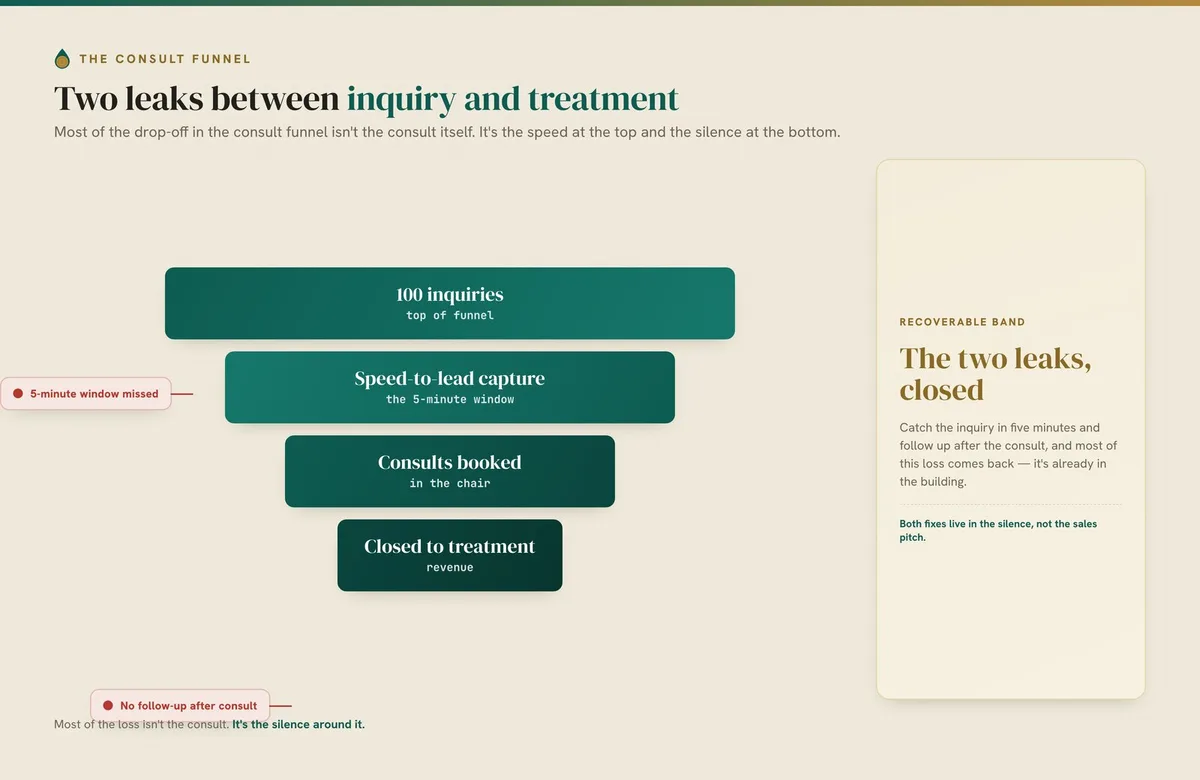
The reply. Someone taps your Botox ad at 9:14 on a Tuesday night and fills out the form. They have your page open, and probably two competitors’ pages too. The reply arrives the next afternoon, when the front desk works through the queue. By then they’ve booked with whoever answered first. The book’s figure is blunt: about three-quarters of practices miss the five-minute window. For a small budget, one lost lead is half the month’s spend.
The handoff. A fast reply isn’t enough if it ends in “someone will call you.” Only 22–25% of med spa bookings happen online, and up to 40% of new leads drop off in call-to-book, slow-response flows. If your ad sends people to a homepage with a general contact form and no way to book, the ad did its job and the page undid it. We covered what the page itself needs to do separately.
The price question. “How much is lip filler?” is the most common first message, and most practices handle it badly. Refusing to quote reads as hiding. A bare per-syringe number invites the patient to shop it. The better reply asks what they’re hoping for, then gives a starting price or range from a sheet you’ve approved.
This is consult follow-up in its purest form: the marketing worked, the patient raised a hand, and the practice didn’t close the loop.
Why does the offer matter more on a small budget?
Because a small budget can’t afford to buy the wrong patient. The instinct is to make the ad work harder with a deal: $9 a unit, 30% off a first HydraFacial. It usually does raise inquiries. But 73% of patients acquired on a discount never return at full price, and a first visit sold at a loss only pays if there’s a second.
Run the numbers on one paid lead. A patient who comes in for a full-price $600 filler visit and keeps coming back is worth an estimated $3,000 over the relationship (the conservative lifetime value). A patient who comes in for a $400 treatment discounted 30% pays $280 and, three times out of four, doesn’t come back at full price. Same $100 to acquire. Very different patients. The Groupon hangover is the long version of that story.
The alternative isn’t a weaker ad. It’s a specific one: one treatment, one kind of patient, a clear starting price and a way to book. “Natural-looking Botox, starting at $X, book a 15-minute consult this week” gives the right person a reason to act without teaching them to wait for a sale.
A note on claims: before/after images, weight-loss promises and GLP-1 drug names in ads are regulated, and the rules vary by state and product. Run any of those past your counsel or medical director before the ad goes live.
What is a small budget worth when the follow-up works?
Put the leak into dollars. Consult close rates typically run 25–35%; practices that work their follow-up (a fast reply, a real answer, two follow-up touches) reach 45% or higher.
24 leads × 0.30 close = about 7 new patients a year
24 leads × 0.45 close = about 11 new patients a year
4 extra patients × $3,000 LTV = $12,000 in lifetime value (estimate)
That’s on $2,400 of annual ad spend, with nothing changed about the ad. And it assumes the new patients stay. Industry benchmarks put first-visit return at 50% or below in a leaking practice and 65% or more in a healthy one, so the booked second visit is part of the ad’s return, not a separate project. A patient who books once and disappears is a $100 lead that bought one ticket.
How do you make a small ad budget pay?
Three changes, in this order. None of them raise the budget.
1. Answer inside five minutes, including nights. Turn on an instant, specific auto-reply for every ad form and message channel: it names the treatment they asked about and promises two times first thing tomorrow. Name the one person who works the overnight queue before anything else each morning. That’s most of the fix.
2. Send the ad to a page that books. One treatment, the same words as the ad, a starting price and a booking button or a two-field form. Not the homepage.
3. Close the first visit with the second. The provider names the next visit in the chair, and the desk books it before checkout. That’s what turns a $100 lead into a $3,000 patient.
Then measure the only number that matters on a small budget: of this month’s inquiries, how many booked, and how many of those booked again. Change the ad only after that number is healthy. Until then, the ad isn’t what’s broken.
What does AI actually do for a small ad budget?
The instant reply is ordinary automation. Your form tool, PMS or booking software can already send a message the moment someone submits; that’s a setting, not AI.
AI earns a place in the conversation that follows, especially after hours. A price question at 10 p.m. needs a real answer: what are you hoping for, here’s the starting range, here are two times tomorrow. An assistant working from your approved price sheet and live calendar can hold that conversation and book the slot, handing anything clinical to a person in the morning. It can also read every inquiry and outcome together, so you can see whether leads went cold because they were poor or because nobody answered them well. On a budget this small, the difference between those two is the whole return.
FAQ
Is $200 a month enough for med spa ads?
It can be, as long as you treat it as a couple of dozen inquiries a year and handle each one well. At roughly $100 per lead, the return depends far more on reply speed, the price conversation and rebooking than on the ad itself.
What should a med spa pay per lead?
It varies widely by market and treatment. The book’s example practice pays about $100 per paid lead, and industry benchmarks put the full cost of acquiring a new patient at $200–$500. Judge each channel by cost per booked visit, not cost per lead.
Should a med spa run discount offers in ads?
Be careful. Discounts raise inquiries, but 73% of patients acquired on a discount never return at full price. A specific treatment with a clear starting price usually brings in patients who stay.
Why do my ad leads never book?
Most often it’s what happens after the click: a reply that comes hours later, a contact form with no way to book, or a price question that goes unanswered. Test your own form after hours tonight before you change the ad.
Should I send ad traffic to my homepage?
No. Send it to a page about the one treatment the ad promised, with the same words, a starting price and a way to book in a couple of clicks.
A note on these figures: the $100-per-lead cost, 25–35% and 45%+ close rates and $3,000 lifetime value come from the book’s example practice and industry ranges; your costs will differ by market. The 74% speed-to-lead figure, the discount-return figure and the online-booking and lead-drop-off ranges are industry benchmarks. The 24-lead math and the $600 and $400 tickets are illustrative. Check them against your own ad account and PMS before you plan around them.
Written by Bill Eisenhauer, Founder of Alchemy Inside.
Revenue & Growth
How much revenue is slipping through your follow-up gaps?
This article explored one category. The free diagnostic scores all six — and gives you a dollar estimate in 90 seconds.
Take the Free Diagnostic