Discounting Is Costing Your Practice More Than the Discount
A 20% discount on Botox doesn't cost you 20% of the sale. It costs you 20% of the margin — and attracts Groupon patients who never convert to full-price or membership.

Bill Eisenhauer
June 26, 2026 · 9 min read
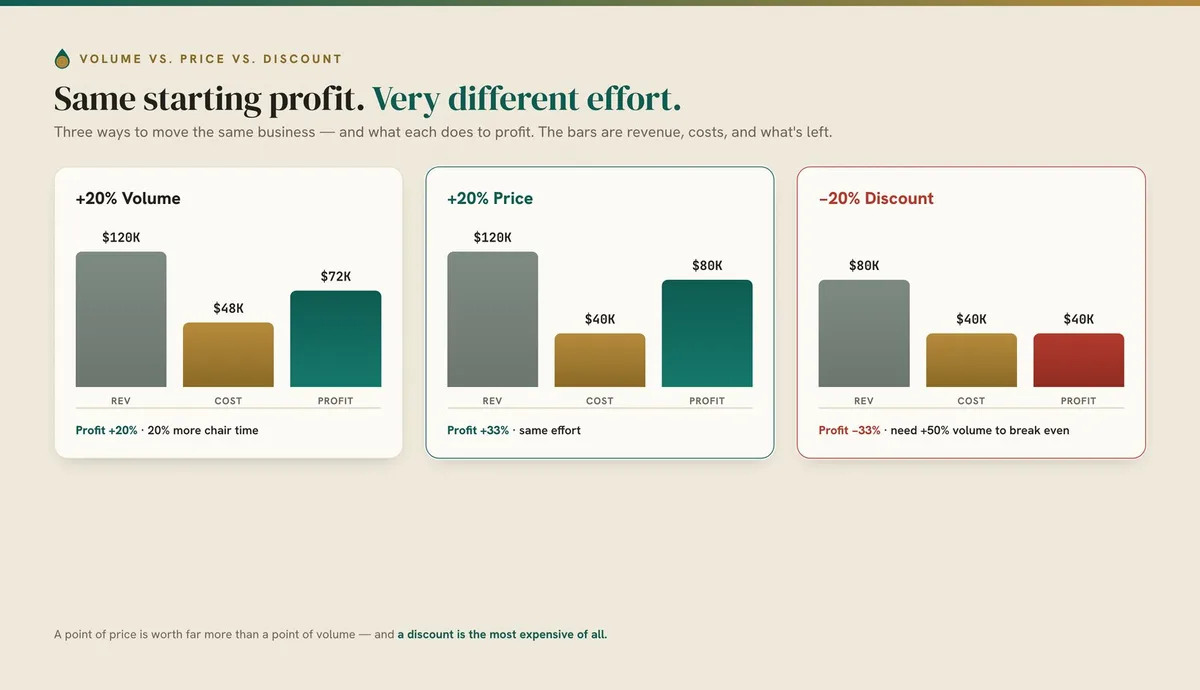
Discounting hurts a med spa more than it helps because the discount comes straight off margin, not revenue. A 20% discount on treatments typically destroys 36% of gross profit — and the deal-seeking patients it attracts churn at 2-3x the rate of full-price patients, generate fewer referrals, and demand more service time. Pricing analysis across healthcare and service industries consistently shows that a 1% improvement in price realization has 2-4x the profit impact of a 1% improvement in patient volume.
Which means the reverse is also true. Every 1% you discount costs you 2-4x as much in profit as losing 1% of your patients. Discounting feels like a small concession. Mathematically, it’s the most expensive decision a cash-pay practice can make.
At a glance
- A 20% discount on treatments costs 36% of gross profit because the discount comes off revenue while costs stay fixed
- Deal-site patients churn at 2-3x the rate of full-price patients and fewer than 8% convert to full-price or membership
- When patients push back on price, the real issue is almost always a value gap in your consultation, not an affordability problem
- Practices that eliminate discounting and reposition around outcomes and expertise routinely see revenue increase even as patient volume drops
What does a 20% discount actually cost?
Not 20%. Far more.
Take a med spa doing $80,000/month with 55% gross margins on treatments. Gross profit is $44,000. If they discount 20% across the board — running a Groupon for Botox, slashing filler pricing, offering “introductory” rates on body contouring — revenue drops to $64,000. But the product cost, injector time, and room overhead haven’t changed. Gross profit drops to $28,000.
That’s a 36% profit reduction from a 20% discount. The discount comes straight off the top; the costs stay where they are.
To maintain the same $44,000 gross profit at discounted prices, the practice would need to increase patient volume by 57% — fifty-seven percent more appointments, fifty-seven percent more treatment rooms in use, fifty-seven percent more injector hours. Most practices can’t absorb that kind of volume increase without hiring another provider and extending hours. So the discount doesn’t just cost margin — it forces either a profit cut or a growth treadmill that’s unsustainable.
Why does habitual discounting attract the wrong patients?
The data on Groupon and deal-site patients versus full-price patients tells a consistent story across cash-pay practices:
Deal-site patients have 2-3x higher churn rates. They entered the relationship optimizing for price, not outcomes. When the next Groupon for a competing med spa appears — and it will — they leave. The relationship was transactional from the first unit of Botox.
Deal-site patients generate fewer referrals. A patient who paid full price and saw real results tells friends: “They’re worth it — my skin has never looked this good.” A patient who paid 40% less tells friends: “Wait for a deal.” You’re training your local market to delay treatments and hunt for coupons.
Deal-site patients demand more. This seems counterintuitive — they paid less, so shouldn’t they expect less? But the data suggests the opposite. Price-sensitive patients are also service-sensitive. They’re more likely to dispute results, request free touch-ups, and leave negative reviews when their discounted Botox doesn’t deliver a premium experience. They cost more to serve while paying less for the privilege.
An aesthetics practice I analyzed ran their numbers after a year of Groupon dependency for filler and neurotoxin treatments. Their deal-site patients had higher complaint rates, more no-shows, and dramatically lower retention than full-price patients. Fewer than 8% of Groupon patients ever converted to full-price or joined a membership. When the practice eliminated deal-site promotions and repositioned around outcomes and expertise, they lost roughly 20% of patient volume — and profit increased significantly. The patients who left were precisely the ones the practice was losing money serving.
What’s actually happening when a patient asks for a discount?
Three scenarios, and only one of them is really about price:
Scenario 1: They don’t see the value. This is the most common case. The patient isn’t cheap — they’re unconvinced. Your consultation hasn’t clearly articulated the expected outcome, the provider’s expertise, or how your approach differs from the med spa down the street advertising $8/unit Botox. Discounting treats the symptom (price resistance) while ignoring the cause (value gap). The fix is a better consultation, not a lower price.
Scenario 2: They’re comparison shopping on price. If a prospect’s primary selection criterion is cost-per-unit or cost-per-syringe, they’re not your patient. A practice that wins on price will lose to the next practice that prices lower. Competing on price is a strategic decision that requires a cost structure built for it — and most cash-pay practices don’t have one.
Scenario 3: They genuinely can’t afford it. This is the rarest case, and the easiest to solve. Offer a smaller treatment plan — fewer units, one syringe instead of two, a single-area treatment instead of full face. You’re not discounting — you’re right-sizing. The per-unit value stays the same; the treatment plan changes. You can also offer membership pricing or a payment plan that maintains your rate integrity.
The distinction matters. In scenario 1, the fix is consultation and proof. In scenario 2, the fix is letting them go. In scenario 3, the fix is treatment plan structure. In none of them is the fix “charge less for the same injection.”
What do practices with pricing power do differently?
Every case study I’ve analyzed on premium pricing points to the same conclusion: pricing power comes from context, not the treatment itself.
The same syringe of filler is $450 at a volume-driven med spa and $1,200 at a physician-led aesthetics practice with before-and-after portfolios and a six-month follow-up protocol. The same GLP-1 prescription is $399/month from a telehealth mill and $800/month from a metabolic health practice with body composition tracking, nutrition coaching, and accountability check-ins. The product hasn’t changed — the context has.
The elements that create pricing context:
Specificity. “Med spa” commands lower treatment fees than “facial balancing and rejuvenation practice specializing in natural aesthetics for women 35-55.” The narrower the positioning, the higher the defensible price — because the patient perceives expertise, not generalism.
Proof. Every before-and-after gallery, patient testimonial, and documented outcome reduces the patient’s perceived risk — and perceived risk is the primary thing suppressing your price. A practice with 50 documented transformations can charge 30-50% more than one with a stock-photo website.
Scarcity. Limited availability — whether real (only 12 new-patient slots per month) or structural (waitlist for injectable appointments) — signals demand. Demand signals quality. Quality supports price.
A med spa I analyzed stopped discounting entirely, repositioned from general aesthetics to outcomes-focused facial rejuvenation and body contouring, and raised treatment prices 25%. They lost roughly 15% of their patient base. Revenue increased from $960,000 annually to over $1.1 million — with fewer patients, less chair time, and dramatically better margins. The patients who remained were higher-value, more compliant, and more likely to refer.
What does AI actually do for pricing?
AI can diagnose your pricing gaps in ways that would take a consultant weeks. An AI pricing analysis pulls your treatment history, segments patients by service mix and profitability, identifies where you’re undercharging relative to your own precedent (the patients paying full price for the same Botox that another patient got at 30% off via a deal site, proving the market will bear it), and flags where discounts are concentrated — by provider, by treatment type, by acquisition channel.
The pattern that surfaces most often: inconsistent pricing across similar treatments. One patient pays $650 per syringe of filler while another pays $425 for the same product and technique — not because of a strategic reason, but because one came through Groupon and you never moved them to full price. AI makes this inconsistency visible, giving you the data to normalize pricing upward across your patient base rather than defaulting to whatever number each deal site extracted.
Key takeaways
- A 20% discount costs 36% of gross profit, not 20%. The discount comes off revenue; costs stay fixed. To maintain the same profit at discounted prices, you’d need to increase patient volume by 57% — which most practices can’t absorb without hiring.
- Groupon and deal-site patients are more expensive to serve and less likely to stay. They churn at 2-3x the rate, generate fewer referrals, and demand more service. Eliminating deal-site dependency often improves both profitability and patient quality simultaneously.
- When a patient asks for a discount, the real issue is usually value, not price. Before reducing your fee, ask whether your consultation clearly articulates the expected outcome, the provider’s expertise, and the differentiation. If it doesn’t, fix the consultation — don’t lower the number.
- Start with one change: the next time a prospect pushes on price, respond with a treatment plan adjustment instead of a discount. “I can adjust the treatment plan to fit that budget — here’s what that looks like” preserves your per-unit value while respecting their constraint.
- Find out where your pricing gaps are hiding. Take the free Alchemy Inside diagnostic to see where discounting and revenue leaks are affecting your practice.
Frequently asked questions
Why is discounting so damaging for med spas specifically?
Med spas operate on fixed costs that don’t shrink with the discount — product costs, injector time, room overhead, and equipment leases stay the same regardless of what you charge. Because treatments already carry significant fixed costs, a 20% discount doesn’t reduce profit by 20%. It reduces profit by 36% or more depending on your margin structure. Unlike retail, where volume can compensate for thinner margins through lower per-unit costs, a med spa can’t inject Botox faster or use less product just because the price is lower.
How do I stop discounting without losing too many patients?
The transition works best when you replace discounts with value rather than simply raising prices. Start by eliminating deal-site promotions and redirecting that marketing spend toward consultation improvements, before-and-after documentation, and patient education. Introduce membership or loyalty programs that reward retention at full price rather than attracting one-time deal seekers. Practices that make this shift typically lose 15-20% of their patient base — but those patients were the lowest-margin, highest-churn segment. Revenue and profit usually increase within two to three months.
What should I say when a patient asks for a discount?
Reframe the conversation around treatment plan options rather than price concessions. Instead of lowering your per-unit rate, offer to right-size the treatment: fewer units, a single area instead of multiple areas, or a phased approach spread over two appointments. You can say something like, “I can adjust the treatment plan to fit that budget — here’s what that looks like.” This preserves your per-unit value while respecting the patient’s financial constraints. If the patient is purely price-shopping, they were never going to become a long-term, full-price patient anyway.
How do I know if my practice has a discounting problem?
Look at three numbers: your average revenue per treatment compared to your published pricing, the percentage of patients who came through deal sites versus direct channels, and your patient retention rate segmented by acquisition source. If your average realized price is more than 10% below your published rate, if more than 20% of new patients come from deal sites, or if deal-site patients retain at less than half the rate of direct patients, discounting is likely eroding your margins. An AI-driven pricing analysis can surface these patterns quickly by segmenting your treatment history by patient source and profitability.
Can membership pricing replace discounting?
Membership pricing is structurally different from discounting because it trades a modest per-treatment reduction for predictable recurring revenue and higher lifetime patient value. A patient paying $199/month for a membership that includes regular treatments and priority booking is generating consistent revenue and is far more likely to add services over time than a Groupon patient who came for one discounted treatment. The key is that membership pricing rewards commitment and retention, while discounting rewards price sensitivity and one-time transactions.
Bill Eisenhauer is the founder of Alchemy Inside, where he helps med spas and aesthetic practices find revenue they are leaving on the table — without adding headcount or buying more software.
Revenue & Growth
How much revenue is slipping through your follow-up gaps?
This article explored one category. The free diagnostic scores all six — and gives you a dollar estimate in 90 seconds.
Take the Free Diagnostic