The $100,000 Already Inside Your Practice
Most growth advice is about getting more patients. The fastest path to an estimated extra $100K is usually inside the practice you already run — six leaks.

Bill Eisenhauer
June 10, 2026 · 11 min read
Hidden revenue in a cash-pay practice hides across six operational gaps that nobody owns: pricing that hasn’t kept pace with your outcomes, cross-sell moments left empty, rebooking that doesn’t happen at checkout, lapsed patients nobody reactivates, membership conversions nobody tracks, and losses nobody catches. Most practices with $500K-$3M in revenue are losing 5-15% of gross revenue to these gaps. In a practice running 30% net margins, a 5% revenue leak consumes a third of your available profit.
At a glance
- Six categories of revenue leaks — pricing, cross-sell, rebooking, lapsed patient reactivation, membership conversion, and loss prevention — account for most of the hidden money.
- A 5% improvement across all six compounds to roughly 34% revenue growth in year one, without acquiring a single new patient.
- Nobody in your practice is accountable for revenue that was never captured — it doesn’t appear on any dashboard because it was never measured.
- A four-step audit (map touchpoints, score pricing, run loss prevention, calculate compound impact) typically surfaces $50,000-$150,000 in addressable gaps.
That’s not a rounding error. That’s a second provider’s salary sitting in your operations, unnoticed.
Every cash-pay practice owner I’ve talked to wants more patients. It’s the default growth instinct — more leads, more Instagram reach, more consult requests. But when I dug into the financial efficiency data to build the Revenue dimension of the diagnostic, a different picture emerged: the fastest path to significant new revenue almost never runs through patient acquisition.
It runs through the money you’re already generating but not capturing.
When you study the financial mechanics of cash-pay practices — med spas, aesthetics clinics, weight-loss practices, hormone therapy offices, longevity centers — a pattern emerges that’s uncomfortable in its simplicity: most practices with $500K-$3M in revenue are losing 5-15% of gross revenue to gaps they’ve never measured. In a practice running 30% net margins, a 5% revenue leak consumes a third of your available profit.
Where does $100,000 hide in a practice doing $1M?
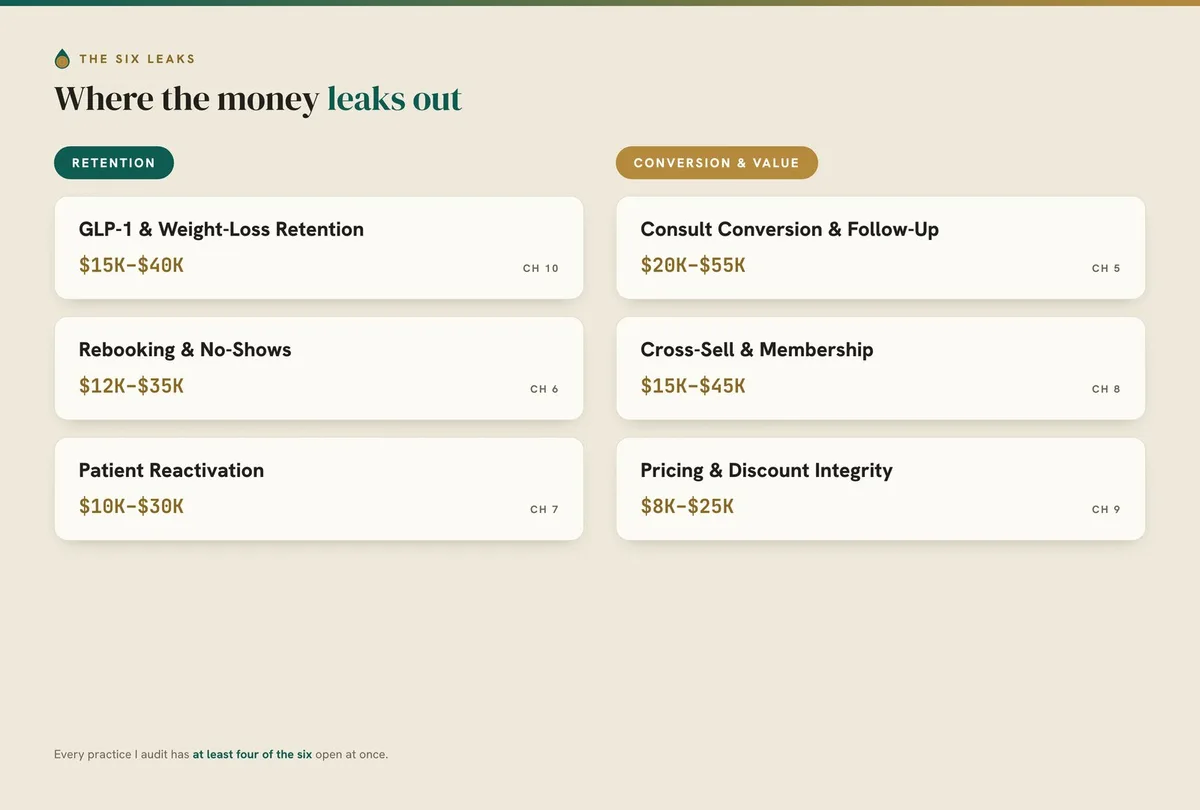
It hides across six categories of leaks that nobody owns. Most practices have significant gaps in at least four:
Pricing gaps (typically 5-15% of revenue). Your per-unit injectable rates were set when you had fewer injectors, a smaller patient base, and a weaker reputation. They haven’t kept pace. Your membership pricing was benchmarked against competitors when you launched — but your outcomes, reviews, and expertise have moved well beyond that starting point. A 10% price increase on a $1M practice adds $100,000 in revenue — and the data across cash-pay practices shows patient loss rates of 1-3% for moderate increases. The math almost always favors the raise.
Cross-sell gaps (3-9% of revenue). Every patient interaction has natural extension points that most practices leave empty. A patient on GLP-1 protocol is a natural candidate for body contouring as they lose weight — but nobody mentions it. A Botox patient who’s never been offered a skin care membership. A facial patient who’d be an ideal candidate for a hormone consultation. The cross-sell you’re not making compounds at every treatment room visit. One aesthetics practice found that 44% of their revenue came from treatments beyond the first visit — memberships, cross-modality add-ons, expanded treatment plans. But only after they built the system to offer them.
Rebooking gaps (5-10% of revenue). Your injector finishes a treatment and the patient walks to the front desk. The front desk is juggling check-ins and a product question. The patient leaves without rebooking. No rebooking attempt at checkout, no cross-modality suggestion, no membership offer, no referral ask, no post-treatment follow-up text. Each gap is small. Together, they represent thousands in annual revenue per provider.
Lapsed patient reactivation (variable, often 5-15% of recoverable revenue). Every practice has patients who came in three times, loved the results, and simply drifted away. Not because they were dissatisfied — because nobody reached out. A practice with 2,000 patients in its PMS and a 40% lapse rate has 800 people who already trust you and have already paid you. Reactivation costs a fraction of acquisition.
Membership conversion gaps (3-8% of revenue). Most cash-pay practices offer a membership program but convert less than 15% of eligible patients. The patients who come in quarterly for injectables and pay per-visit are leaving money on the table for both of you. They’d save money on a membership, you’d get predictable monthly recurring revenue — but if no one systematically offers it at the right moment, the conversion doesn’t happen.
Loss prevention gaps (5-15% of revenue). This is the category that surprises owners most. Product samples given away without tracking. Retail inventory shrinkage. Add-on treatments performed but never billed. Device lease terms nobody renegotiates. Skincare product margins nobody recalculates. PMS features you’re paying for but not using. Marketing tools with overlapping functionality both auto-renewing. The data suggests three conditions enable loss: perceived need, ability to rationalize, and opportunity to go undetected. The only one you control is opportunity — and if you’re not actively measuring it, the leakage is happening.
Follow-up gaps (variable, often 5-20% of pipeline value). Covered in depth in The Follow-Up Gap, but worth emphasizing here: every consult inquiry that got one response — or none — and was never touched again is revenue that was nearly captured and then abandoned. In one med spa, this single gap accounted for $36,000 in annual lost revenue.
Why don’t practice owners see this money?
Because each gap is small in isolation. $200/month in PMS features nobody uses. $500/month in injectable pricing that hasn’t moved. $400/month in missed cross-sell moments. $300/month in unbilled add-ons. $250/month in lapsed patients who would rebook with a text. $150/month in membership conversions that never happened. Individually, none of these trigger an alarm. Collectively, they’re $22,800/year — and that’s a conservative example from only six line items.
The second reason is structural: nobody in your practice is accountable for revenue that was never captured. Your injectors track treatments delivered. Your front desk tracks appointments booked. Your bookkeeper tracks what comes in and goes out. But the revenue that should have been generated and wasn’t? That’s a ghost — it doesn’t appear on any dashboard because it was never measured.
This is the difference between a “treatment culture” and a “practice growth culture.” A treatment culture depends on individual providers remembering to mention the membership, suggest the next modality, ask for the referral. A practice growth culture builds systems that capture value at every touchpoint — automatically, consistently, without relying on someone remembering to ask between patients.
How do you find the money that’s already there?
The diagnostic approach that shows up consistently in the data is a four-step audit:
Step 1: Map your patient journey end-to-end. From first inquiry through treatment, checkout, and beyond, list every point where a patient interacts with your practice. Most cash-pay practices have 8-15 touchpoints. Now mark which ones include a revenue opportunity (a cross-modality offer, a membership pitch, a rebooking prompt, a referral ask) and which are “dead” touchpoints that capture no value.
Step 2: Audit your pricing against your current value. Pull your injectable rate card and membership pricing from two years ago. Compare it to today’s. If the numbers are the same but your technique, reputation, and patient outcomes have improved, you have a pricing gap. Score your practice on three dimensions: outcome clarity (can you name the specific result?), proof strength (can you show before-and-afters and reviews?), and competitive differentiation (why you over someone cheaper?). High scores on all three mean your price has room to move.
Step 3: Run the loss prevention scan. Export three months of recurring charges and look for PMS features nobody uses, marketing tools with overlapping functions, device leases nobody has renegotiated, and retail products with margins nobody has recalculated. Cross-reference treatment logs against billing records for add-ons performed but not charged. This typically surfaces $3,000-$12,000 in annual savings within two hours of work.
Step 4: Calculate the compound impact. The compound math is instructive: if you can improve revenue by just 5% across six different categories — pricing, cross-sell, rebooking, reactivation, membership conversion, and loss prevention — the compound effect isn’t 30%. It’s closer to 34% in year one, and it compounds further each year because the base grows. Over four years, consistent 5% improvements across multiple categories can approach a 4x increase in revenue — without acquiring a single new patient.
What does AI actually do here?
This is where AI earns its keep — not in finding the categories (the framework above does that), but in doing the analysis that would take a practice manager weeks.
An AI audit system can ingest your bank statements, PMS data, and billing history, then map every recurring charge, flag billing anomalies, identify patients whose visit frequency has dropped, surface pricing outliers where similar patients pay different rates for the same treatment, and calculate your actual membership conversion rate against your addressable base. What takes a consultant three days of spreadsheet work, AI does in an afternoon — and it catches patterns humans miss because it doesn’t get tired on row 3,000.
More practically: AI can monitor these categories continuously. Instead of running an annual audit and finding $15,000 in leaks that accumulated over 12 months, an AI system flags the PMS subscription the week it stops being used, the add-on treatment that was performed but never billed, and the patient whose engagement pattern matches your lapse profile. The audit becomes ongoing rather than episodic — and the leaks get smaller because they’re caught earlier.
Explore each gap
Each article below digs into one specific revenue leak — what it costs, why it happens, and how to fix it.
Revenue & Pricing
- 86% of Your Patients Expect a Skincare Recommendation. Only 14% Get One.
- Why Your Best Marketing Campaign Stops Working After 90 Days
- The Recurring Revenue Engine: Adding $3,000/Month Without a Single New Patient
- Your Membership Program Has 12 Members. Here’s What’s Actually Wrong.
- The Growth Ceiling Nobody Talks About: When the Owner Is the Bottleneck
- Your Practice Website Converts at 1.8%. Here’s What’s Missing.
- The Groupon Hangover: How One Discount Campaign Permanently Broke Your Practice’s Pricing
- Discounting Is Costing Your Practice More Than the Discount
- The 2,000 Names You’re Sitting On: A $24K Reactivation Playbook for Cash-Pay Practices
- The Objection You Never Hear: Why Consults Don’t Convert in Cash-Pay Practices
- What Happens Between ‘I’m Interested’ and ‘I’ll Think About It’: The 5-Minute Follow-Up Rule
- The GLP-1 Retention Cliff: Why 65% of Your Weight-Loss Patients Will Be Gone in 12 Months
- The No-Show Tax: What 3 Empty Chairs a Week Actually Costs Your Med Spa
- The Follow-Up Gap: Where Most Cash-Pay Practices Lose $36,000 a Year
- You’re Probably Undercharging by 30%. Here’s How to Know for Sure.
- The Reactivation Playbook: Recovering $20K From Patients Who Already Trust You
- The Cross-Sell You’re Not Making: Why Existing Patients Are Your Cheapest Revenue
- The Proof Stack: How to Charge 30% More by Showing What You’ve Already Done
- The Referral Revenue You’re Not Collecting: $3,000–$15,000 a Year
Data & Patients
- The Patient Who Left Last Month Tried to Tell You in October
- The 5 Numbers Every $1M Practice Should Check Monthly
- Why Your Best Patients Leave — and the 90-Day Warning Signs You’re Missing
- What Your Patients Won’t Tell You Is Costing You $50,000 a Year
Workflow & Operations
- What a $25/Hour VA Can Do With a Documented Process (That a $150/Hour Owner Shouldn’t)
- The Front Desk Is Your Highest-Paid Salesperson (And They Don’t Know It)
- The Capacity Trap: How Busy Practice Owners Work 60 Hours and Still Can’t Grow
- One Documented Process Is Worth $144,000 a Year: Write Down Your Checkout
- Your Provider Spends 14 Hours a Week Not Treating Patients
Tools & Costs
Key takeaways
- Most cash-pay practices with $500K-$3M in revenue have 5-15% of gross revenue hiding in six operational gaps they’ve never measured — pricing that hasn’t moved, cross-sells nobody offers, rebooking that doesn’t happen at checkout, lapsed patients nobody reactivates, membership conversions nobody tracks, and losses nobody catches.
- A 5% improvement across six categories compounds to roughly 34% revenue growth in year one — without a single new patient. Over four years, consistent marginal improvements across multiple levers approach a 4x increase.
- Nobody in your practice is accountable for revenue that was never captured. Injectors track treatments, front desk tracks appointments, bookkeeping tracks cash flow — but the ghost revenue doesn’t appear on any dashboard.
- Start with the four-step audit: map your patient touchpoints, score your pricing against current value, run the loss prevention scan, and calculate the compound impact. Most practice owners find $50,000-$150,000 in addressable gaps within the first pass.
- Take the free diagnostic to see where your practice stands across all four dimensions — and which revenue gaps to close first.
Frequently asked questions
Where is the hidden revenue in a med spa or cash-pay practice?
Hidden revenue in cash-pay practices typically sits across six categories: pricing that hasn’t kept pace with improved outcomes and reputation, cross-sell opportunities left empty during patient visits, rebooking that doesn’t happen at checkout, lapsed patients nobody reactivates, membership conversions nobody systematically offers, and operational losses nobody catches (unbilled add-ons, unused software, untracked product samples). Most practices with $500K-$3M in revenue are losing 5-15% of gross revenue to these gaps.
How much revenue can a med spa recover without adding new patients?
Practices that address all six revenue-leak categories — pricing, cross-sell, rebooking, reactivation, membership conversion, and loss prevention — typically find $50,000-$150,000 in addressable gaps on the first audit. A 5% improvement across six categories compounds to roughly 34% revenue growth in year one. Over four years of consistent marginal improvements, the compound effect can approach a 4x increase in revenue without acquiring a single new patient.
Why don’t practice owners notice revenue leaks?
Two reasons. First, each individual gap is small — $200/month in unused PMS features, $500/month in stale pricing, $400/month in missed cross-sells. None of these trigger an alarm on their own. Second, nobody in the practice is accountable for revenue that was never captured. Injectors track treatments delivered, front desk tracks appointments, bookkeeping tracks cash flow — but revenue that should have been generated and wasn’t is a ghost that doesn’t appear on any dashboard.
What is the fastest way to find hidden revenue in a cash-pay practice?
The fastest approach is a four-step audit: (1) map every patient touchpoint end-to-end and mark which ones include a revenue opportunity, (2) audit your pricing against your current value — outcomes, reputation, and proof — not the rates you set two years ago, (3) run a loss prevention scan by exporting three months of recurring charges and cross-referencing treatment logs against billing records, and (4) calculate the compound impact across all six categories. Most practice owners complete this in a single focused day.
Can AI help find revenue leaks in a med spa?
AI helps in two ways. First, it accelerates the initial audit — ingesting bank statements, PMS data, and billing history to flag anomalies, identify lapsed patients, surface pricing outliers, and calculate membership conversion rates against the addressable base. What takes a consultant three days of spreadsheet work, AI does in an afternoon. Second, AI can monitor these categories continuously, flagging the unused subscription the week it stops being used, the add-on that was performed but never billed, and the patient whose engagement pattern matches a lapse profile — turning an annual audit into an ongoing system.
Bill Eisenhauer, Founder of Alchemy Inside, builds diagnostic and AI-audit systems for cash-pay practices. This article is part of the Revenue dimension of the practice growth diagnostic.
Revenue & Growth
How much revenue is slipping through your follow-up gaps?
This article explored one category. The free diagnostic scores all six — and gives you a dollar estimate in 90 seconds.
Take the Free Diagnostic