The Reactivation Playbook: Recovering $20K From Patients Who Already Trust You
Your lapsed patients are 5x cheaper to re-engage than new consult inquiries. Most cash-pay practices never contact them again — and the revenue sitting in that list is significant.

Bill Eisenhauer
May 27, 2026 · 8 min read
To reactivate lapsed med spa patients, run a four-step outreach sequence over 31 days: a warm reconnection text and email, a two-week follow-up, a farewell message, and a personal call from the provider. Practices that execute this sequence typically recover 10-15% of lapsed patients at a fraction of the cost of acquiring new consult inquiries. The personal call is the highest-converting step and the one most practices skip.
At a glance
- Lapsed patients are 5x cheaper to win back than acquiring new consult inquiries through paid ads — the trust barrier is already cleared.
- The #1 reason patients leave is they forgot about you, not dissatisfaction — a simple outreach fixes most lapses.
- A four-step sequence over 31 days (warm outreach, follow-up, farewell, personal call) consistently recovers 10-15% of inactive patients.
- AI turns reactivation into a continuous system that flags patients the moment they cross the inactivity threshold, instead of waiting for someone to remember to run a campaign.
A hormone therapy practice with 210 lapsed patients — people who’d completed at least one treatment cycle but hadn’t rebooked in 14 months — ran a simple reactivation campaign. Three touches over 28 days (text, email, then postcard), followed by a personal call from the practice owner.
Recovery rate: 13%. Twenty-seven patients came back. At an average patient annual value of $3,600 (monthly protocols plus periodic treatments), that’s $97,200 in recovered revenue from a campaign that cost $2,800 to execute. Cost per reactivated patient: $104 — compared to the $650+ they typically spent acquiring a new consult inquiry through paid ads.
This isn’t a hormone therapy story. It’s a math story. And the math applies to every cash-pay practice with a list of lapsed patients gathering dust.
Why are lapsed patients so much cheaper to win back?
Because the hardest work is already done. They already know your practice. They’ve already experienced your care. They’ve already paid out of pocket — which means they’ve already cleared the mental hurdle of investing in themselves. The trust barrier that makes new patient acquisition expensive — “who are you, and why should I believe you?” — doesn’t exist.
One business strategist who studied reactivation across dozens of industries ranked the difficulty of every sale type:
- Current patient (easiest)
- Referral from current patient
- Lapsed patient reactivation — the third easiest booking in business
- New patient from cold outreach (5-7x more expensive)
Most practices pour their marketing budget into #4 while ignoring #3 entirely. The lapsed patient list sits in the PMS, untouched, losing value with every month of silence.
Why do patients go inactive in the first place?
The data points to six reasons, ranked by frequency:
They forgot about you. This is the #1 reason — and the most fixable. Life got busy. They traveled. Their schedule shifted. Your practice simply dropped out of their awareness. Not because of a bad experience. Not because of a competitor. Just because you stopped being present.
They found another practice. A competitor showed up at the right time — maybe closer, maybe with a newer modality. This is recoverable — the relationship wasn’t damaged, just interrupted.
The experience was mediocre. Not bad enough to leave a review. Not good enough to remember. The dangerous middle where patients drift away without a clear trigger.
Results plateaued or weren’t communicated. A GLP-1 patient lost 18 pounds in the first three months, then stalled. Without a provider conversation about recalibrating the protocol, they assumed it stopped working. A med spa patient didn’t see the cumulative benefit of their treatment plan explained — so they stopped after two sessions instead of completing six.
The insight that changes the calculus: the vast majority of lapsed patients didn’t leave angry. They left unattended. A simple, genuine outreach recovers them — not because your offer is irresistible, but because it reminds them you exist. This is the same dynamic behind The Follow-Up Gap — the revenue you lose isn’t from bad service, it’s from silence.
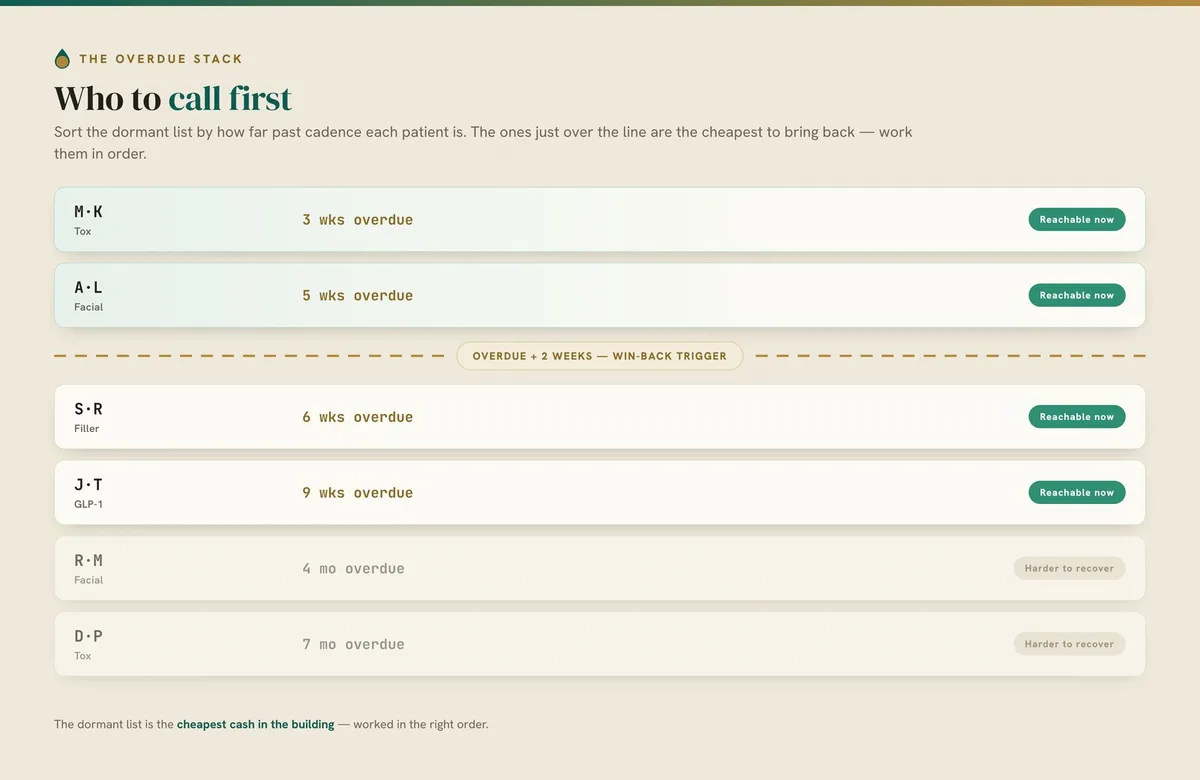
What does a reactivation campaign actually look like?
The sequence that produces the most consistent results across cash-pay verticals is a four-step campaign over 31 days:
Step 1 (Day 0): The warm outreach. Not a sales pitch — a genuine reconnection. “We noticed it’s been a while since your last visit — we’ve added new modalities since then, and we’d love to show you what’s changed.” Include a specific offer — a complimentary skin assessment, a free body composition scan, a returning-patient discount on their next treatment. The offer removes the friction of rebooking. Text and email together; text gets opened, email carries the detail.
Step 2 (Day 14): The “we’re still here” follow-up. Reference the first outreach. “We reached out a couple weeks ago — just wanted to make sure you saw it. We’ve set aside a few returning-patient slots this month.” This catches the patients who intended to respond but got busy. It’s not pushy — it’s persistent.
Step 3 (Day 28): The last chance. “This is our last note — we don’t want to be a nuisance. But our door is always open when you’re ready.” Counterintuitively, the farewell message often produces the highest response rate. The prospect of the relationship ending triggers action in patients who were on the fence.
Step 4 (Day 31): The personal call. The practice owner or lead provider calls the patients who haven’t responded. This is the step most practices skip — and it’s the highest-converting touch. A personal call from the provider who treated them signals importance that no text or email can match. The hormone therapy practice’s owner made 45 calls and booked 9 appointments from this step alone.
What does AI actually do for reactivation?
AI transforms reactivation from a one-time campaign into a continuous system. An AI reactivation engine monitors your patient database and flags accounts the moment they cross the inactivity threshold — 60 days, 90 days, whatever fits your treatment cycle. It segments lapsed patients by their history (what treatments they had, how much they spent, how recently they were active) and generates personalized outreach for each segment — not a generic blast, but a message that references their specific past engagement. “It’s been 4 months since your last GLP-1 refill — patients who restart within 6 months typically maintain their prior weight loss and see faster results the second time.” Or: “Your last microneedling session was in October — spring is an ideal time to restart your skin rejuvenation protocol before summer.” The system manages the four-step sequence automatically, tracks who responds, and escalates the non-responders to the provider’s personal call list. Instead of running one reactivation campaign per year when someone remembers, the system runs continuously — catching patients at 90 days instead of letting them drift for 14 months.
How do you calculate the value sitting in your lapsed patient list?
The audit takes 10 minutes:
Count your lapsed patients. Pull everyone from your PMS who hasn’t booked in the last 6-14 months (define “lapsed” by your typical treatment cycle). A monthly GLP-1 practice might set the threshold at 90 days; a quarterly aesthetics practice at 6 months.
Calculate average past value. What did the average lapsed patient spend with you when they were active? First visits typically run $300-$1,200. Monthly protocols like GLP-1 run $400-$1,000. Memberships run $99-$299/mo. Your recovery potential is the annualized value per patient.
Apply the 13% recovery rate. Multiply lapsed patients x average annual value x 0.13. That’s your conservative reactivation revenue estimate.
For the hormone therapy practice: 210 lapsed patients x $3,600 average annual value x 13% = $98,280. They actually recovered $97,200 — almost exactly what the math predicted.
Key takeaways
- Lapsed patients are 5x cheaper to re-engage than new consult inquiries — and a 13% recovery rate is typical for a well-executed reactivation campaign. Most practices never try because they assume lapsed means uninterested.
- The #1 reason patients go inactive is they forgot about you — not dissatisfaction, not a competitor, just the natural drift of an unattended relationship. A simple outreach fixes this for the majority.
- The four-step sequence (warm outreach, follow-up, last chance, personal call) over 31 days consistently recovers 10-15% of lapsed patients. The personal call from the provider is the highest-converting step and the one most practices skip.
- Calculate your number right now: count your lapsed patients, multiply by average annual patient value, multiply by 13%. That number is revenue sitting in your PMS, waiting for a text and a phone call.
- Find out what else is hiding in your practice. Take the free diagnostic to see where lapsed patients fit into the bigger revenue picture.
Frequently asked questions
How long should a patient be inactive before they’re considered lapsed?
It depends on your treatment cycle. A monthly GLP-1 or hormone therapy practice should flag patients at 90 days of inactivity. A quarterly aesthetics practice might set the threshold at 6 months. The key is defining “lapsed” relative to your expected rebooking interval — not using an arbitrary calendar cutoff.
What should the first reactivation message say?
Lead with genuine reconnection, not a sales pitch. Reference something specific — new modalities, updated protocols, or seasonal relevance. Include a low-friction offer like a complimentary assessment or returning-patient discount. The goal is to remove the awkwardness of rebooking after a gap, not to pressure patients into an appointment.
Is it worth calling lapsed patients personally?
Yes — the personal call from the provider is consistently the highest-converting step in the reactivation sequence. In the hormone therapy example, the practice owner made 45 calls and booked 9 appointments from that step alone. Patients who ignored texts and emails often respond when the person who actually treated them picks up the phone.
How often should I run a reactivation campaign?
Ideally, reactivation should be continuous rather than a one-time campaign. An automated system that flags patients the moment they cross the inactivity threshold catches them at 90 days instead of letting them drift for over a year. If you are running manual campaigns, quarterly is the minimum frequency to keep the lapsed list from growing faster than you can recover it.
What recovery rate should I expect from a reactivation campaign?
A well-executed four-step sequence typically recovers 10-15% of lapsed patients. The 13% figure is a reliable planning number for practices that complete all four steps including the personal call. Practices that skip the call or send only one message see lower returns — often 3-5%.
Bill Eisenhauer is the founder of Alchemy Inside where he helps med spa and cash-pay practice owners find the revenue already hiding in their business — without adding headcount, buying more ads, or switching platforms.
Revenue & Growth
How much revenue is slipping through your follow-up gaps?
This article explored one category. The free diagnostic scores all six — and gives you a dollar estimate in 90 seconds.
Take the Free Diagnostic