The Follow-Up Gap: Where Most Cash-Pay Practices Lose $36,000 a Year
Most consult inquiries don't say no — they just never hear from you again. Here's what that silence actually costs a med spa or aesthetics practice, and why the fix is simpler than you think.

Bill Eisenhauer
June 05, 2026 · 7 min read
The average cash-pay practice loses $19,000 to $72,000 per year from consult inquiries that received one response — maybe — and were never contacted again. The gap isn’t bad leads or price shoppers; it’s a systems failure where 70-85% of inquiry value quietly disappears because no structured follow-up sequence exists. Fixing it costs $50-150/month in automation tools, not a platform overhaul.
Not bad inquiries. Not price shoppers. Consult inquiries that came in, got one response — maybe — and were never touched again.
In one case — a med spa running three treatment rooms — this single gap accounted for $36,000 in annual lost revenue. The practice manager wasn’t surprised. She knew inquiries were slipping through. She just didn’t know the dollar figure.
At a glance
- $36,000/year lost by a single med spa from consult inquiries that needed nothing more than a second and third touch
- 5-20% of “lost” prospective patients book when given a structured, multi-touch follow-up sequence
- 80% drop in conversion odds after 48 hours without a response — the follow-up cliff is real
- $50-150/month is all the automation costs to close the gap — three timed messages recover more than most ad campaigns
Key takeaways
- The average cash-pay practice loses $19,000-$72,000/year from consult inquiries that received one touch and were never contacted again — the range depends on inquiry volume and treatment value, but the pattern is nearly universal.
- 5-20% of “lost” prospective patients book under structured follow-up. These aren’t new inquiries to generate — they’re already sitting in your PMS.
- The fix costs $50-150/month, not $50,000 in platform overhaul. Three automated messages after an inquiry goes unanswered will recover more revenue than most ad campaigns.
- Start with a 15-minute audit: pull your last 90 days of consult inquiries, count the ones that got no second touch, and multiply by your average first-visit value. That’s your follow-up gap — and it’s probably bigger than you expect.
- Find out exactly where your practice stands — take the free diagnostic →
How does $36,000 disappear without anyone noticing?
It disappears one missed inquiry at a time. A consult request comes in Tuesday through the website form. The front desk is juggling check-ins and a product question. By Thursday nobody’s responded. Friday brings new inquiries from the Instagram campaign. Tuesday’s inquiry sinks to the bottom of someone’s inbox and stays there.
This isn’t a people problem — it’s a systems problem. And it follows a predictable pattern in almost every cash-pay practice I’ve analyzed:
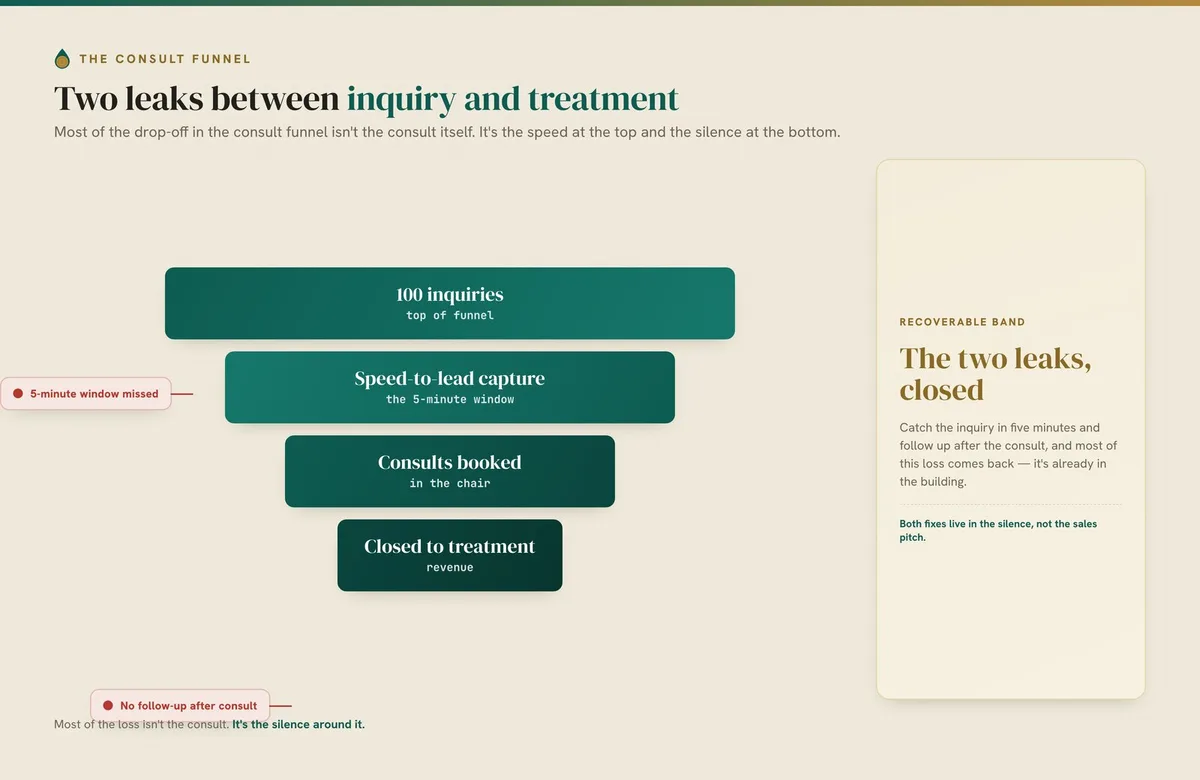
The 48-hour cliff. Inquiry response rates drop dramatically after the first two days. By day five, your odds of converting that prospective patient have fallen by 80% or more. Most practices don’t have a structured follow-up sequence that fires within this window.
The single-touch habit. One text back. Maybe one email. Then nothing. But the data is consistent: 5-20% of “lost” prospective patients will book under structured, multi-touch follow-up. For a practice fielding 60 inquiries a month, that’s 3-12 additional bookings sitting in the dead pile.
The slow-burn blind spot. Some patients take 60, 90, even 180 days to commit. A woman researching facial rejuvenation compares three practices over four months. A man considering hormone therapy needs weeks to talk it over. They’re not uninterested — they’re just not ready yet. Without automated nurture, these prospective patients evaporate.
What does this actually cost a typical cash-pay practice?
Let’s run the math on a practice that generates 60 consult inquiries per month with an average first-visit value of $800.
If your current booking rate is 30%, you’re converting 18 and losing 42. Research suggests structured follow-up recovers 5-20% of those lost prospective patients. Take the conservative end — 5%.
That’s 2 additional bookings per month you’re not getting. At $800 each, that’s $1,600/month or $19,200/year — from inquiries you already paid to attract.
Now factor in the treatment arc. Botox patients come back every 3-4 months. GLP-1 patients spend $400-$1,000/month. Membership patients pay $149/month. A single recovered first visit often yields $2,000-$5,000 in lifetime value. At a 10% recovery rate, you’re looking at 4 extra bookings per month and $36,000+ annually.
The med spa I analyzed landed at $36,000 per year in consult inquiries that needed nothing more than a second and third touch.
Why doesn’t every practice just fix this?
Because it feels like a time problem, not a systems problem. The owner thinks: “We need to be better about following up.” That framing guarantees nothing changes, because nobody at the front desk has slack to manually chase 42 unbooked inquiries per month while managing check-ins and treatment room turnover.
The fix is structural, not motivational. Three parts:
Map the leak first. Pull your consult inquiries from the last 90 days out of your PMS (Boulevard, Zenoti, PatientNow, Aesthetics Pro). Count how many got a response within 24 hours, how many got a second touch, how many got a third. The drop-off is your follow-up gap — and you can put a dollar estimate on it in 15 minutes.
Automate the first three touches. A well-timed text at day 1, an email at day 3, and another text at day 10 will recover more revenue than any Instagram campaign you’re considering. The tools to automate this cost $50-150/month — not a $50,000 platform overhaul.
Segment the slow burns. Prospective patients who don’t book in 30 days aren’t dead — they’re dormant. A monthly check-in (automated, value-driven, not “just circling back”) keeps you in consideration for the 90-180 day buyers every practice has and nobody nurtures. Same principle as The Reactivation Playbook — they’re already in your system and dramatically cheaper to convert than cold leads.
What does the recovery actually look like?
The pattern is consistent: practices that systematically re-engage unbooked inquiries and dormant patients find significant revenue waiting.
One aesthetics practice reactivated their lapsed patient list — people who’d had one treatment but never rebooked — with a “complimentary skin assessment” offer. No hard sell. Just a reason to come back in. The result: 14% reactivation rate, with patients returning for treatments from chemical peels to laser resurfacing.
A hormone therapy clinic found that prospective patients inquiring about testosterone optimization needed 60-90 days to decide. They built a five-touch educational sequence — lab guides, lifestyle content, patient stories — and their 90-day conversion rate climbed from 8% to 22%. Same inquiries. Just a system instead of silence.
These aren’t unicorn outcomes. They’re what happens when you build a system for the 70-85% of inquiry value that most practices quietly waste. It’s why follow-up gaps are the highest-weighted factor in the Revenue & Growth dimension of the diagnostic.
How do I know if this is my problem?
Answer three questions:
-
What percentage of your consult inquiries get a structured follow-up sequence? If the answer is “depends on who’s at the front desk” — you have a follow-up gap.
-
When did you last contact a prospective patient who went quiet more than 30 days ago? If you can’t remember — you have a dormant asset problem.
-
Can you tell me right now how many open consult inquiries are sitting without a response? If you’d need to dig through your PMS to find out — you have a visibility problem.
Most practices have all three.
FAQ
How quickly should a med spa respond to a consult inquiry? Within the first 24 hours, ideally within 5 minutes for text or chat inquiries. Conversion odds drop by 80% or more after 48 hours without a response. The practices that recover the most lost revenue automate their first touch so it fires immediately, regardless of who’s at the front desk.
What’s the best follow-up sequence for unbooked consult requests? A three-touch automated sequence works for most cash-pay practices: a text on day 1, an email on day 3, and another text on day 10. Keep the tone helpful, not salesy — answer a common question, share a quick before-and-after, or offer to hold a spot. For slow-burn prospects (60-180 day decision cycles), add a monthly nurture email with educational content.
How many follow-up touches does it take to book a prospective patient? Data across cash-pay practices consistently shows that 5-20% of prospective patients who went quiet will book under a structured, multi-touch sequence. Most practices stop at one touch. Adding even two or three more contacts — spaced over 10-14 days — captures the majority of recoverable revenue.
How do I calculate how much revenue my practice is losing to follow-up gaps? Pull your consult inquiries from the last 90 days out of your PMS. Count how many received no second contact. Multiply that number by your average first-visit value, then multiply by 5-10% (the conservative recovery range). That’s your annual follow-up gap. A practice with 60 monthly inquiries and an $800 first-visit value typically finds $19,000-$36,000 sitting untouched.
What tools do med spas use to automate follow-up? Most PMS platforms (Boulevard, Zenoti, PatientNow, Aesthetics Pro) include basic automated messaging. For practices needing more flexibility, dedicated tools like GoHighLevel, Klara, or Podium handle multi-channel follow-up (text, email, voicemail drop) for $50-150/month. The tool matters far less than having any structured sequence at all — even a simple three-message drip outperforms manual follow-up.
Written by Bill Eisenhauer, Founder of Alchemy Inside. Bill works with med spas, aesthetics practices, and cash-pay clinics to find and fix the operational gaps that silently drain revenue — using AI-driven diagnostics and structured playbooks that turn hidden losses into recovered growth.
Revenue & Growth
How much revenue is slipping through your follow-up gaps?
This article explored one category. The free diagnostic scores all six — and gives you a dollar estimate in 90 seconds.
Take the Free Diagnostic