The No-Show Tax: What 3 Empty Chairs a Week Actually Costs Your Med Spa
Three missed appointments a week doesn't sound like much. It's an estimated $54,600 a year — plus staff time, room prep and the patients you turned away.

Bill Eisenhauer
June 08, 2026 · 11 min read
Three no-shows a week at an average ticket of $350 is $54,600 a year in empty chairs. That number doesn’t include the staff you prepped, the room you turned over, or the patient on your waitlist you could have booked instead. U.S. healthcare loses over $150 billion annually to missed appointments, and cash-pay practices feel it hardest because there’s no insurance reimbursement to cushion the blow. Every empty slot is revenue that vanishes — not deferred, not delayed, gone.
At a glance
- Three no-shows per week at $350 average = $54,600/year in lost revenue — and that’s before you count staff time, supplies, and the patients you turned away to hold those slots.
- New client no-show rates run 17-22%, roughly double your established patient rate. The first appointment is where most of the damage happens.
- Automated SMS + email reminders reduce no-shows by 34% on average and push show rates above 90%. This is the single highest-ROI fix.
- Cancellation fees recover some revenue but don’t solve the problem. A waitlist system that fills empty chairs in minutes recovers far more than a $50 fee ever will.
Key takeaways
- No-shows cost the average med spa $1,200-$2,000 per month — and practices with higher per-visit revenue (injectables, body contouring, GLP-1 protocols) lose proportionally more per empty slot.
- The real cost is 2-3x the lost appointment revenue when you factor in staff idle time, room prep waste, consumables opened, and the turned-away patient who would have filled that slot.
- New patients are your highest-risk segment. A 17-22% new-client no-show rate means roughly one in five first consults never walks through the door. The acquisition dollars you spent getting them there evaporate.
- The fix isn’t one policy — it’s a system. Reminders, deposits, waitlists, and rebooking workflows working together can cut no-shows by 50% or more.
- Take the free diagnostic –> — no-shows are one of six revenue categories the scorecard evaluates.
What does a no-show actually cost beyond the lost appointment?
Practice owners tend to calculate no-show cost as “the price of the service they didn’t get.” That’s only the starting point. The true cost of an empty chair has at least four layers.
| Cost layer | What it includes | Typical impact |
|---|---|---|
| Direct revenue loss | The service fee the patient would have paid | $200-$600 per appointment |
| Staff idle time | Provider, nurse, front desk — prepped and waiting | 30-60 min of fully loaded labor cost |
| Consumable waste | Room turnover, supplies staged, products prepared | $15-$50 per appointment |
| Opportunity cost | The patient you turned away or didn’t book because the slot was “taken” | Often equal to the original appointment value |
A $400 Botox appointment that no-shows doesn’t cost you $400. It costs you $400 in lost revenue, plus $75 in staff time, plus $20 in supplies, plus the $400 appointment you could have booked in its place. The true cost is closer to $900.
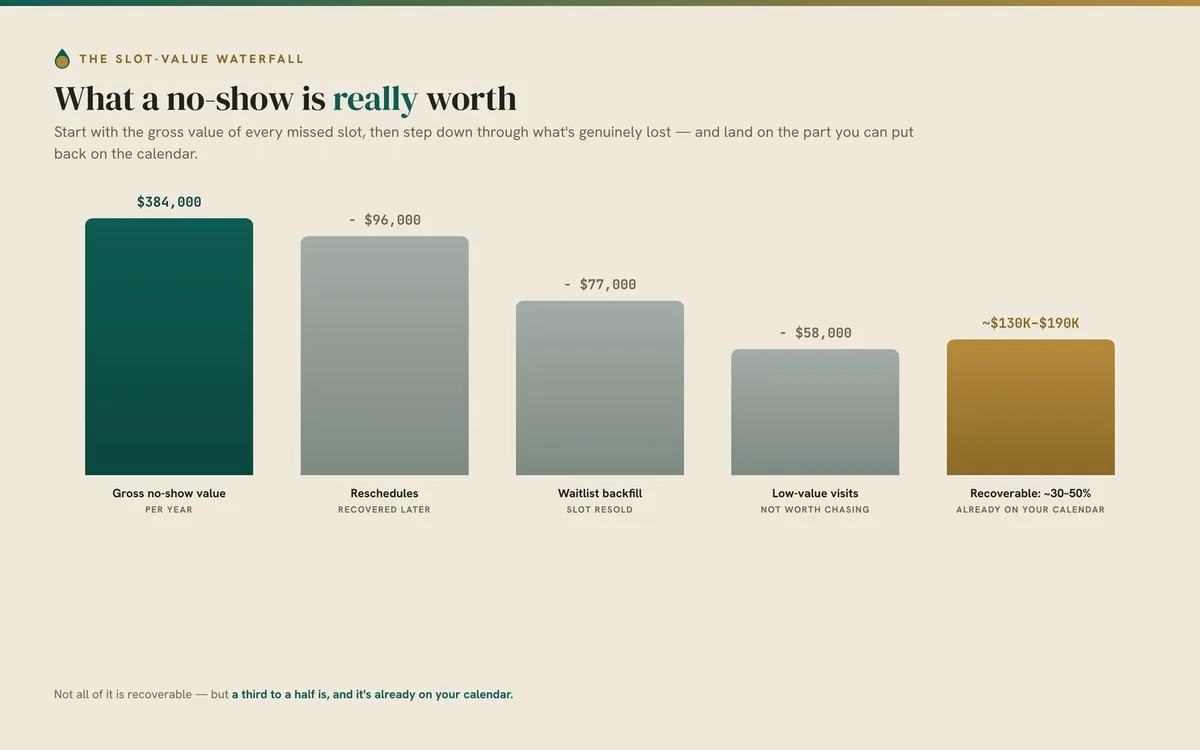
Multiply that by three chairs a week and you’re looking at real money — $140,000+ per year in total economic impact, not just the $54,600 in face-value revenue.
Why are new patient no-show rates so much higher?
New clients no-show at 17-22%, roughly double the rate of established patients. Three factors drive this.
No relationship yet. An established patient who’s been seeing your injector for two years feels a social obligation to show up. A new consult who found you on Google last Tuesday doesn’t. The relationship hasn’t earned enough weight to override a scheduling conflict, a bad night’s sleep, or a last-minute change of heart.
Booking friction creates drop-off. Research shows 71% of clients abandon bookings when the process is difficult or slow. If your new patient intake requires calling during business hours, filling out paper forms, or navigating a clunky online scheduler, you’re losing people between “I want to book” and “I confirmed my appointment.” Every friction point between intent and confirmation is a no-show waiting to happen.
Cold feet are real. First-time patients — especially for injectables, body contouring, or GLP-1 starts — are making a high-stakes decision. Anxiety builds between booking and showing up. Without a confidence-building touchpoint in that gap (a welcome text, a “what to expect” email, a provider introduction video), some percentage will quietly bail.
The fix: treat every new patient booking as provisional until confirmed. A same-day booking confirmation text, a “what to expect” email within 24 hours, and a personal reminder 48 hours before the appointment can cut new-patient no-shows in half.
Do automated reminders actually work?
Yes — and the data is overwhelming. A systematic review of 29 studies found that 97% demonstrated that appointment reminders improved attendance rates. Patients receiving reminders showed a mean reduction in non-attendance of 34% from baseline.
The specific numbers across studies:
- One hospital system dropped no-shows from 11.4% to 7.8% with SMS reminders alone.
- A pediatric practice cut missed appointments from 38.1% to 23.5% — a 14.6 percentage-point drop.
- Another system reduced no-shows from 18.55% to 7.01% using automated multi-channel reminders.
The pattern is consistent: automated reminders push show rates above 90%, and the combination of SMS plus email outperforms either channel alone. Text gets opened (98% open rate within 3 minutes). Email carries the detail — directions, intake forms, what to bring.
The critical finding: timing doesn’t seem to matter as much as you’d think. Whether the reminder goes out 24 hours or 72 hours before the appointment, the effect is similar. What matters is that it goes out at all. Practices running zero automated reminders are leaving the most money on the table.
If you’re still relying on front desk staff to make reminder calls — and 77% of patients prefer calling to reschedule but can’t get through during limited office hours — you’re fighting an unwinnable labor battle. Automate the reminders. Redeploy your front desk to tasks that actually need a human.
Should I charge a cancellation fee?
This is the question every practice owner asks when no-shows spike. “Should I just charge them?” The answer is nuanced.
What cancellation fees do well: They signal that your time has value. They create a financial consequence that makes patients think twice before ghosting. Practices that implement fees — typically $50-$250 depending on the service — do see a measurable reduction in no-shows. Urban You Med Spa reported a 15% reduction in no-shows after implementing a 48-hour cancellation policy with a $250 fee for cosmetic injection appointments.
What cancellation fees do poorly: They don’t fill the empty chair. You collected $50 from someone who didn’t show up for a $400 service. You recovered 12.5% of the revenue and still have an empty room for an hour. Fees also create friction with new patients (who are already your highest no-show risk), generate negative reviews, and require administrative effort to enforce.
The tiered approach that works best: Require a credit card on file at booking. Charge 50% for cancellations within 24 hours. Charge 100% for no-shows. But make the policy easy to find, easy to understand, and consistently enforced. Inconsistent enforcement is worse than no policy — it trains patients that the fee is negotiable.
The real move: pair the cancellation fee with a waitlist system that fills the slot before it goes empty. The fee becomes a safety net, not your primary revenue recovery tool.
How does a waitlist system fill empty chairs?
A waitlist is the difference between a no-show costing you $400 and a no-show costing you $50 (the administrative hassle of the cancellation). When a patient cancels or no-shows, the system immediately notifies everyone on the waitlist who matches that time, provider, and service type. The first client to confirm gets the appointment.
Modern waitlist platforms handle this in minutes, not hours. The workflow:
- Patient cancels or doesn’t show — the system flags the slot as open.
- Automated text goes to waitlisted patients matching the time and service: “A 2:00 PM Tuesday slot just opened for Botox with Dr. Chen. Reply YES to book.”
- First responder confirms — the appointment is rebooked automatically.
- If no one bites in 30 minutes, the system expands the notification to patients due for rebooking or those who expressed interest in that service.
Practices running automated waitlists report filling 60-80% of last-minute cancellations. That transforms the economics: instead of three empty chairs a week costing $54,600 a year, you’re recovering two of those three — reducing the annual loss to under $20,000.
The prerequisite is having enough demand to build a waitlist. If you’re running at 60% capacity, waitlists won’t help — you have a demand problem, not a no-show problem. But most med spas operating at 80%+ utilization have patients who’d happily take an earlier slot. You just need the system to connect the cancellation to the demand in real time.
What does a complete no-show reduction system look like?
No single tactic solves no-shows. The practices that get their rate below 5% are running a system with five interconnected components.
1. Pre-appointment confirmation sequence. Automated text at booking, “what to expect” email within 24 hours, SMS reminder at 48 hours, and a final reminder on the morning of the appointment. New patients get an additional personal touch — a welcome text from their provider or a short video introduction.
2. Deposit or card-on-file requirement. Collect a credit card at booking. For high-value services ($500+), collect a 20-50% deposit. This creates financial commitment that makes the appointment feel real. Deposits alone can reduce no-shows by 20-30%.
3. Cancellation policy with teeth. Clearly communicated, consistently enforced. The patient acknowledges the policy at booking — not buried in fine print, but in the confirmation text. “Please note: cancellations within 24 hours are subject to a 50% fee.”
4. Automated waitlist. Every cancellation triggers immediate outreach to waitlisted patients. The goal is to fill the slot before the staff even knows it’s empty.
5. No-show follow-up workflow. The patient who no-shows isn’t a lost cause — they’re a rebooking opportunity. An automated “we missed you” text within 2 hours, followed by a rebooking link, recovers 15-25% of no-shows within the same week. Don’t punish them with silence. Re-engage them before they drift to a competitor.
When these five components work together, the math changes dramatically:
| Metric | Before system | After system |
|---|---|---|
| No-show rate | 10-15% | 3-5% |
| Revenue lost to empty chairs (annually) | $54,600 | $10,000-$18,000 |
| Cancellation slots refilled | 0% | 60-80% |
| New patient show rate | 78-83% | 90%+ |
How do no-show rates vary by practice type?
Not all cash-pay practices experience no-shows equally. The type of service, patient commitment level, and appointment value all affect the rate.
Aesthetic injectables (Botox, filler): 8-12% no-show rate. Relatively low because these are elective, desired procedures with short appointment times. But the per-appointment revenue is high ($400-$800), so even a modest rate adds up fast.
Medical weight loss / GLP-1 clinics: 12-18% no-show rate. Higher because ongoing protocols require sustained commitment. Month-3 drop-off is common — early enthusiasm fades when results plateau. The early warning signs of patient churn often start with a skipped GLP-1 check-in.
Body contouring / laser treatments: 10-15% no-show rate. Multi-session protocols (4-6 treatments) see increasing no-shows as the series progresses. Patients who skip session 3 rarely complete session 6 without intervention.
New patient consults (all types): 17-22% no-show rate. Regardless of service type, first appointments are the highest-risk category. The patient has the least commitment and the most uncertainty.
The target benchmark for aesthetic practices: keep your overall no-show rate under 10%, and your established-patient rate under 5%. If you’re above these numbers, the system described above will close the gap.
FAQ
How do I calculate what no-shows are costing my practice right now?
Pull your no-show count from the last 90 days (your PMS tracks this). Divide by total appointments to get your rate. Multiply your weekly no-show count by your average appointment value. Then multiply by 52 for the annual cost. A practice running 80 appointments per week with a 10% no-show rate and $400 average ticket: 8 no-shows x $400 x 52 = $166,400 per year. That’s the floor — the real cost is higher when you factor in staff time and opportunity cost.
Should I require deposits for all appointments or just high-value ones?
Start with high-value services ($500+) and all new patient consults — these are your highest-risk, highest-cost no-show categories. If deposits create too much booking friction for lower-value services, a card-on-file policy achieves a similar effect with less upfront resistance. The key is that the patient has financial skin in the game before the appointment.
What’s the best timing for appointment reminders?
Research shows timing matters less than consistency. That said, the most effective sequence is: confirmation at booking, a reminder 48 hours before (giving them time to reschedule rather than just not show), and a final reminder the morning of. Three touchpoints outperform one, regardless of exact timing.
How do I handle repeat no-shows without losing the patient?
After a second no-show, move the patient to a “deposit required” tier — they can still book, but they pay 50% upfront. Frame it as a scheduling commitment, not a punishment: “To hold your preferred time slot, we ask for a deposit that applies to your treatment.” Most patients accept this without friction. The chronic no-shows who won’t pay a deposit are patients who were costing you money anyway.
Won’t cancellation fees hurt my Google reviews?
They can — if the policy surprises people. The practices that avoid review blowback do three things: communicate the policy clearly at booking (not after the no-show), give a grace period for first offenses, and enforce consistently so it feels fair rather than arbitrary. A policy that everyone knows about generates far less resentment than a fee that appears out of nowhere.
My front desk says they don’t have time to manage a waitlist. What do I do?
They shouldn’t have to. An automated waitlist system handles the notification, confirmation, and rebooking without front desk involvement. The average practice juggles 14 separate vendor systems — if your scheduling platform doesn’t include waitlist automation, it’s costing you the equivalent of one empty chair per week in lost revenue. The software pays for itself in the first month.
Written by Bill Eisenhauer, Founder of Alchemy Inside.
No-shows are one of six revenue categories in our free diagnostic. The scorecard evaluates your practice across retention, consults, no-shows, cross-sell, reactivation, and pricing — and identifies where the largest recoverable revenue is hiding.
Revenue & Growth
How much revenue is slipping through your follow-up gaps?
This article explored one category. The free diagnostic scores all six — and gives you a dollar estimate in 90 seconds.
Take the Free Diagnostic