The GLP-1 Retention Cliff: Why 65% of Your Weight-Loss Patients Will Be Gone in 12 Months
Most cash-pay practices lose two-thirds of their GLP-1 patients within a year. Here's the dollar cost, the three predictable drop-off windows, and the retention system that changes the math.

Bill Eisenhauer
June 12, 2026 · 9 min read
Most GLP-1 weight-loss programs have a built-in revenue problem: nearly two-thirds of patients stop treatment within 12 months. A 2025 retrospective cohort of 125,474 adults found that 64.8% of patients without type 2 diabetes discontinued GLP-1 therapy within one year. They don’t leave all at once. They leave in three predictable waves — and each wave has a different cause and a different fix. If your practice bills $400/month per GLP-1 patient, a 50-patient program losing at the published rate is hemorrhaging roughly $156,000 a year in preventable attrition.
At a glance
- 64.8% of weight-loss GLP-1 patients quit within 12 months, and the drop-off follows three predictable windows: month 1 (side effects), months 3-4 (stalled progress), and months 6-9 (perceived completion).
- The top two reasons for discontinuation are cost (47.6%) and side effects — both are manageable with proactive systems, not clinical heroics.
- Patients who stop regain roughly two-thirds of lost weight within a year, which means every patient who leaves without a maintenance plan will eventually need to restart — or will go to a competitor who offers one.
- Dose-stepping and reduced-frequency protocols (such as every-two-week dosing) can cut patient costs while maintaining results, giving practices a retention tool that also improves margins.
Key takeaways
- The attrition is predictable. Three distinct drop-off windows account for the majority of losses. Mapping your patient exits to these windows tells you exactly where your system is failing.
- Side effects drive early exits; cost drives late exits. Patients who leave in month 1 needed better titration management. Patients who leave in month 6 needed a financial bridge to maintenance dosing.
- “Goal weight reached” is a silent killer. Patients who lose weight and assume they’re done will regain two-thirds of it within a year. The practice that transitions them to a maintenance protocol keeps the revenue and the outcome.
- Structured communication programs improve 12-month persistence by 34-42%. This isn’t about more clinical skill — it’s about systematic check-ins, side-effect triage, and milestone messaging.
- Every retained GLP-1 patient is worth $4,800/year. At $400/month, the math is simple. Retaining even 10 additional patients changes annual revenue by $48,000.
What does the GLP-1 drop-off actually look like?
The attrition doesn’t happen randomly. It clusters in three windows, each with a distinct cause:
| Drop-off window | % of total attrition | Primary driver | What’s missing |
|---|---|---|---|
| Month 1 | ~30% | GI side effects (nausea, vomiting) | Proactive titration management, expectation-setting |
| Months 3-4 | ~20% | Plateau frustration, stalled weight loss | Progress reframing, dose adjustment, body composition data |
| Months 6-9 | ~15% | “I hit my goal weight” or cost fatigue | Maintenance transition protocol, dose-stepping to reduce cost |
The first wave is the largest and the most preventable. Gastrointestinal symptoms — nausea, vomiting, constipation — are directly related to GLP-1’s mechanism of action. They’re worst during initial titration and after dose increases. Patients who aren’t warned in advance, or who don’t have a clear path to managing symptoms, simply stop showing up.
A Cleveland Clinic analysis found that side effects drive early discontinuation, while financial constraints become the barrier for longer-term patients. The implication for practice owners: your month-1 problem and your month-6 problem require completely different interventions.
Why do patients really leave?
Cleveland Clinic data on GLP-1 discontinuation breaks down the reasons:
- 47.6% cite cost — insurance denial, coupon expiration, or out-of-pocket burden
- Side effects — primarily GI symptoms during titration
- Less-than-desired efficacy — patients expected faster or greater weight loss
- Fear of uncommon adverse effects — media coverage of rare risks
- Perceived completion — “I lost the weight, so I’m done”
Notice what’s absent from this list: dissatisfaction with the practice. Patients aren’t leaving because they’re unhappy with you. They’re leaving because no system is in place to manage the predictable obstacles that every GLP-1 patient encounters.
The cost objection deserves special attention in cash-pay practices. Your patients are paying out of pocket from day one. By month 6, they’ve spent $2,400 or more. If they’ve hit a weight-loss target, the value proposition shifts from “I’m losing weight” to “I’m paying to maintain” — and without reframing, that feels like a downgrade. The practice that proactively introduces maintenance dosing at reduced frequency (and reduced cost) keeps the patient. The practice that waits for the patient to raise the concern loses them.
What happens when GLP-1 patients stop?
The research here is unambiguous and is the single most important piece of information your patients aren’t hearing:
- Two-thirds of lost weight is regained within 12 months of stopping (Lancet eClinicalMedicine meta-analysis)
- Return to baseline weight occurs by approximately 18 months, at a rate of about 0.8 kg/month
- Weight regain after GLP-1 discontinuation is roughly 4x faster than regain after behavioral weight-loss programs
- Cardiovascular benefits reverse after stopping, according to Washington University research
This data is your retention argument. Patients who understand that stopping means regaining are far more likely to transition to a maintenance protocol than to walk away. But here’s the key: they need to hear this at month 1, not month 8 when they’re already considering quitting. The conversation about long-term treatment should start on day one.
What does a GLP-1 retention system look like?
Retention isn’t a single tactic. It’s a system with interventions mapped to each drop-off window:
Month 1: Survive the side-effect window
- Pre-treatment expectation call. Before the first injection, a 10-minute call covering: expected GI symptoms, timeline for improvement, when to call vs. wait it out, and the concrete plan for titration adjustment.
- Day 3 and Day 7 check-ins. Text or call. Not “how are you feeling?” but specific: “Rate your nausea 1-10. Any vomiting in the last 24 hours?” This gives your team data to act on before the patient decides to quit.
- Rapid titration adjustment protocol. If GI symptoms are severe, the provider slows the titration schedule. The patient knows this in advance — “we’ll adjust the pace to what your body can handle” — so severity doesn’t feel like failure.
Months 2-4: Bridge the plateau
- Body composition tracking. Patients plateau on the scale but are still losing fat and gaining lean mass. Without body composition data, a stall feels like failure. With it, a stall becomes “your body is recomposing.”
- Monthly progress review. Not just weight — measurements, energy levels, clothing fit, lab values. Reframe the narrative from “pounds lost” to “health gained.”
- Dose optimization. Patients on a dose that’s producing diminishing returns need adjustment, not abandonment. Weekly monitoring with dose flexibility keeps progress visible.
Months 5-9: Transition to maintenance
- Introduce maintenance framing by month 4. Don’t wait for the patient to say “I think I’m done.” The provider should proactively raise the concept: “You’re approaching your target range. Here’s how we transition to a maintenance protocol that costs less and keeps your results.”
- Dose-stepping protocol. Scripps Health research demonstrated that 87% of patients (26 of 30) maintained their weight loss when switched from weekly to every-two-week or less frequent dosing. Patients retained 72% of their weight loss on reduced frequency. For cash-pay patients, this can cut monthly cost by 50% — a powerful retention tool.
- Lifestyle program integration. Nutrition counseling, exercise programming, and habit coaching give patients a reason to stay connected to your practice even as medication frequency decreases. These services also create cross-sell opportunities.
How much is GLP-1 attrition actually costing your practice?
Here’s the math for a representative cash-pay practice:
| Metric | Value |
|---|---|
| Active GLP-1 patients | 50 |
| Monthly revenue per patient | $400 |
| Annual revenue at full retention | $240,000 |
| 12-month attrition rate (published) | 64.8% |
| Patients lost in 12 months | ~32 |
| Average months before departure | 4.5 |
| Revenue lost to attrition | ~$156,000/year |
That $156,000 doesn’t account for the acquisition cost of replacing those 32 patients. If your cost to acquire a new GLP-1 patient is $200-$500 (marketing, consult time, labs), you’re spending an additional $6,400-$16,000 just to refill the pipeline. The total cost of unmanaged attrition: $162,000-$172,000 per year in a 50-patient program.
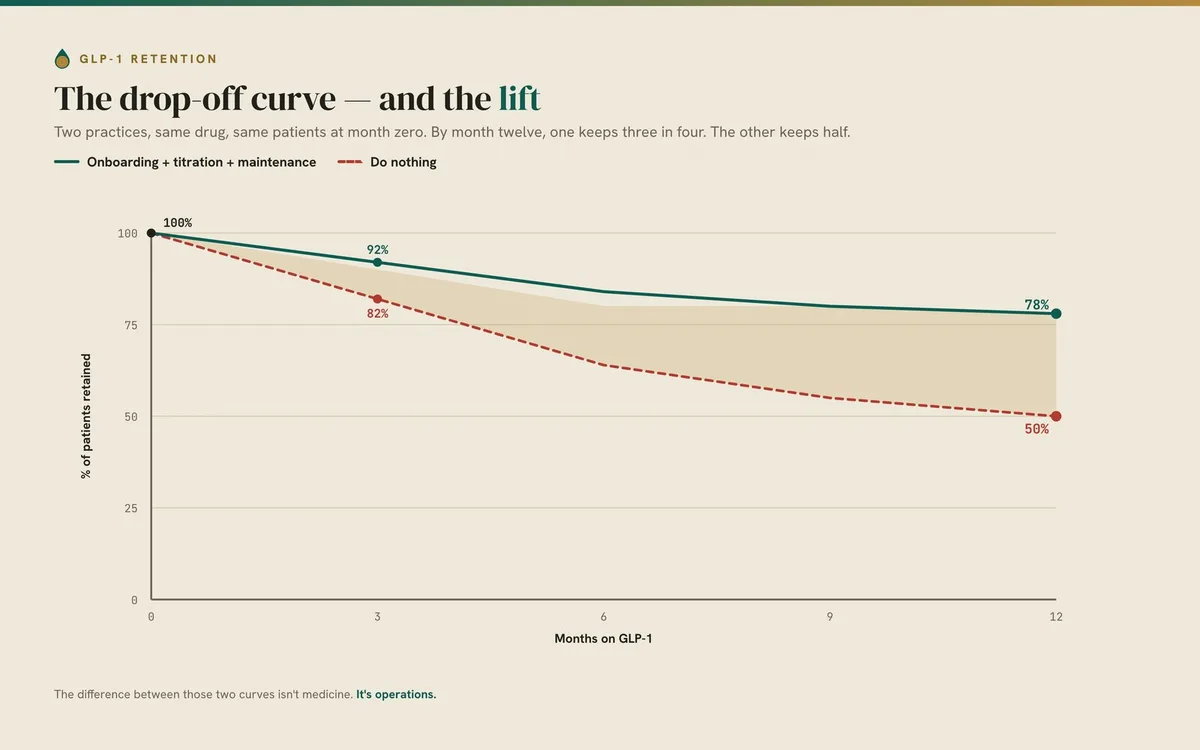
Now compare: what if a structured retention system moved your 12-month attrition from 65% to 40%? You’d retain 12 additional patients. At $400/month, those 12 patients represent $57,600 in annual revenue — plus the $2,400-$6,000 in acquisition costs you didn’t need to spend.
What about patients who already left?
Reactivation is a separate play — and it’s one of the six categories we evaluate in every practice diagnostic. Patients who stopped GLP-1 therapy and regained weight are high-probability reactivation candidates because:
- They already trust your practice
- They’ve experienced the drug’s efficacy firsthand
- They now have direct, personal evidence that stopping leads to regain
- They’re likely frustrated and looking for a solution
A structured reactivation campaign — timed to 4-6 months post-discontinuation, when weight regain becomes undeniable — can recover 15-25% of lost patients. The message isn’t “come back.” The message is: “We have a maintenance protocol now that costs less and keeps you from cycling.”
Does structured communication actually move the needle?
Clinical studies report 34-42% improvements in 12-month medication persistence among patients enrolled in structured digital support programs versus those receiving no support. A 2026 analysis in the Journal of Medical Internet Research found that higher digital engagement was associated with greater weight loss outcomes among GLP-1 patients.
This isn’t about clinical sophistication. It’s about systematic touchpoints:
- Week 1: Side-effect check-in (text or call)
- Week 2: Progress acknowledgment + expectation-setting
- Week 4: First monthly review + body composition baseline
- Monthly: Progress review, dose assessment, goal recalibration
- Month 4: Maintenance protocol introduction
- Month 6: Cost-reduction conversation (dose-stepping option)
- Quarterly after month 6: Maintenance check-in + cross-sell (skin tightening, body contouring, nutrition programs)
Each touchpoint has a specific purpose. None of them require the provider’s time — they can be handled by a trained coordinator, an automated system, or a combination of both.
FAQ
How many GLP-1 patients does a typical cash-pay practice lose in a year?
Published data shows 64.8% of weight-loss GLP-1 patients discontinue within 12 months. For a practice with 50 active patients at $400/month, that translates to approximately $156,000 in lost annual revenue. The losses cluster in three predictable windows: month 1 (side effects), months 3-4 (plateau frustration), and months 6-9 (perceived completion or cost fatigue).
What’s the number one reason GLP-1 patients stop treatment?
Cost, at 47.6% according to Cleveland Clinic research. Side effects are the second most common reason. The timing matters: side effects drive early discontinuation (month 1), while financial constraints drive later exits (months 6+). For cash-pay practices, this means proactive dose-stepping and maintenance pricing are essential for long-term retention.
Can patients maintain weight loss on a reduced GLP-1 dose?
Yes. Scripps Health research found that 87% of patients maintained their weight loss when switched from weekly to every-two-week or less frequent dosing. Patients retained 72% of their weight loss on the reduced schedule. For practice owners, this is a retention and margin play: lower medication cost for the patient, sustained revenue for the practice, and a clinical outcome that supports long-term treatment.
What happens to patients who stop GLP-1 medication entirely?
On average, patients regain approximately two-thirds of their lost weight within 12 months of stopping. A Lancet eClinicalMedicine meta-analysis found that return to baseline weight occurs by about 18 months, with regain happening roughly 4x faster than after behavioral weight-loss programs. Cardiovascular benefits also reverse after discontinuation.
How much does a retention system improve GLP-1 persistence?
Structured digital support and communication programs improve 12-month medication persistence by 34-42% compared to no support. The interventions aren’t complex: systematic check-ins, proactive side-effect management, progress tracking, and milestone-based messaging. A trained coordinator or automated system can handle most touchpoints without consuming provider time.
Should I reactivate GLP-1 patients who already left?
Yes — and 4-6 months post-discontinuation is the optimal window. By that point, most patients have experienced meaningful weight regain and are receptive to a return. The reactivation message should focus on your maintenance protocol and reduced-cost options, not on restarting the full program. Practices that run structured reactivation campaigns recover 15-25% of lapsed patients.
Written by Bill Eisenhauer, Founder of Alchemy Inside. We help cash-pay medical practices find and recover the revenue already inside their practice. Retention is one of six categories in our free diagnostic — take the scorecard to see where your practice stands.
Revenue & Growth
How much revenue is slipping through your follow-up gaps?
This article explored one category. The free diagnostic scores all six — and gives you a dollar estimate in 90 seconds.
Take the Free Diagnostic