Your Membership Program Has 12 Members. Here's What's Actually Wrong.
Most med spa memberships fail because they sell a discount instead of a treatment journey. Membership patients spend 2-4x more annually — but only when the program is built around cross-sell, not cost savings.

Bill Eisenhauer
July 08, 2026 · 10 min read
Med spa memberships fail because they’re built as discount programs, not treatment journeys. When a membership is just “10% off everything for $99/month,” patients do the math, realize they don’t visit often enough to justify it, and cancel within 90 days. The practices that build memberships around bundled treatments, cross-modality progression, and expanding patient goals don’t struggle with enrollment — they struggle to keep up with demand. The difference isn’t marketing. It’s structure.
At a glance
- Membership patients spend 2-4x more annually than non-members, but only when the program creates a treatment pathway — not just a price break.
- Most practices cross-sell only when the provider remembers to mention it. That’s not a system. That’s a hope.
- ARPU growth via treatment bundles is the easiest revenue lever in a cash-pay practice — easier than new patient acquisition, cheaper than paid advertising, and more predictable than seasonal promotions.
- 60% of first-time patients never return for a second treatment. A well-structured membership is the mechanism that converts one-time visits into ongoing relationships.
Key takeaways
- A membership program isn’t a pricing strategy — it’s a cross-sell engine. The monthly fee is the least important part. What matters is the treatment bundle that expands over time.
- Twelve members means you have a positioning problem, not a demand problem. Patients don’t understand what the membership gives them beyond a discount — and a discount alone isn’t enough to sustain a monthly commitment.
- The “provider remembers to mention it” model leaves five figures on the table annually. Systematic cross-sell at defined trigger points converts at 3-5x the rate of ad hoc mentions.
- Treatment bundles should answer the question your patients are already asking: “What should I do next?” Not “What else can we sell you?”
- Find out where your practice’s membership gap sits. Take the free diagnostic →
Why do most med spa memberships fail?
The typical med spa membership: $99-$149/month, one treatment (usually a facial or a set number of Botox units), everything else discounted 10-20%. The practice launches it, signs up 8-15 patients, and watches enrollment stall.
Three months later, cancellations start. Six months later, the owner says, “Nobody signs up for our membership.” The program gets shelved.
The problem isn’t that patients don’t want memberships. Discount-only memberships fail three tests simultaneously:
The math test. A patient visiting quarterly for Botox at $12/unit doesn’t save enough at 10% off to justify $99/month. They do the arithmetic — $1,188/year in fees versus $200 in savings — and the program makes no sense.
The identity test. A membership should make the patient feel like they belong to something. “10% off” doesn’t create identity. “You’re on a skin health program that includes quarterly injectables, monthly facials, and a personalized regimen” does. The first is a coupon. The second is a commitment to a result.
The progression test. The best memberships evolve as the patient evolves. A patient who starts with Botox and facials should naturally progress into fillers, skin resurfacing, and advanced treatments as their goals expand. A flat discount program doesn’t create that pathway. A treatment bundle does.
What should a med spa membership include?
The memberships that grow past 12 members share a structure. They’re not built around discounts — they’re built around treatment bundles that answer the question: “What should I do next?”
Here’s what separates a 12-member program from a 100-member program:
| Feature | Struggling program (12 members) | Growing program (50-100+ members) |
|---|---|---|
| Core offer | Percentage discount on treatments | Bundled treatments included monthly |
| Cross-sell mechanism | Provider mentions it if they remember | Defined progression path per tier |
| Patient identity | “I get a discount” | “I’m on a skin health program” |
| Upsell pathway | None | Tier upgrades as goals expand |
| Retention trigger | Price — easy to cancel | Treatment plan — harder to abandon |
| Monthly value clarity | Vague | Specific treatments, specific dates |
A membership that works typically includes three components:
A core monthly treatment. Something the patient receives every month — a signature facial, a hydrafacial, a microneedling session, a set number of injectable units. This is the anchor. It’s what gets them in the door 12 times a year instead of 2-4 times.
A cross-modality benefit. This is where real revenue lives. Not 10% off everything — a specific offer on a specific adjacent service. “Your membership includes one complimentary lip treatment per quarter” is more compelling and more profitable than “15% off all fillers.” It introduces patients to treatments they wouldn’t have tried otherwise — exactly the cross-sell most practices miss.
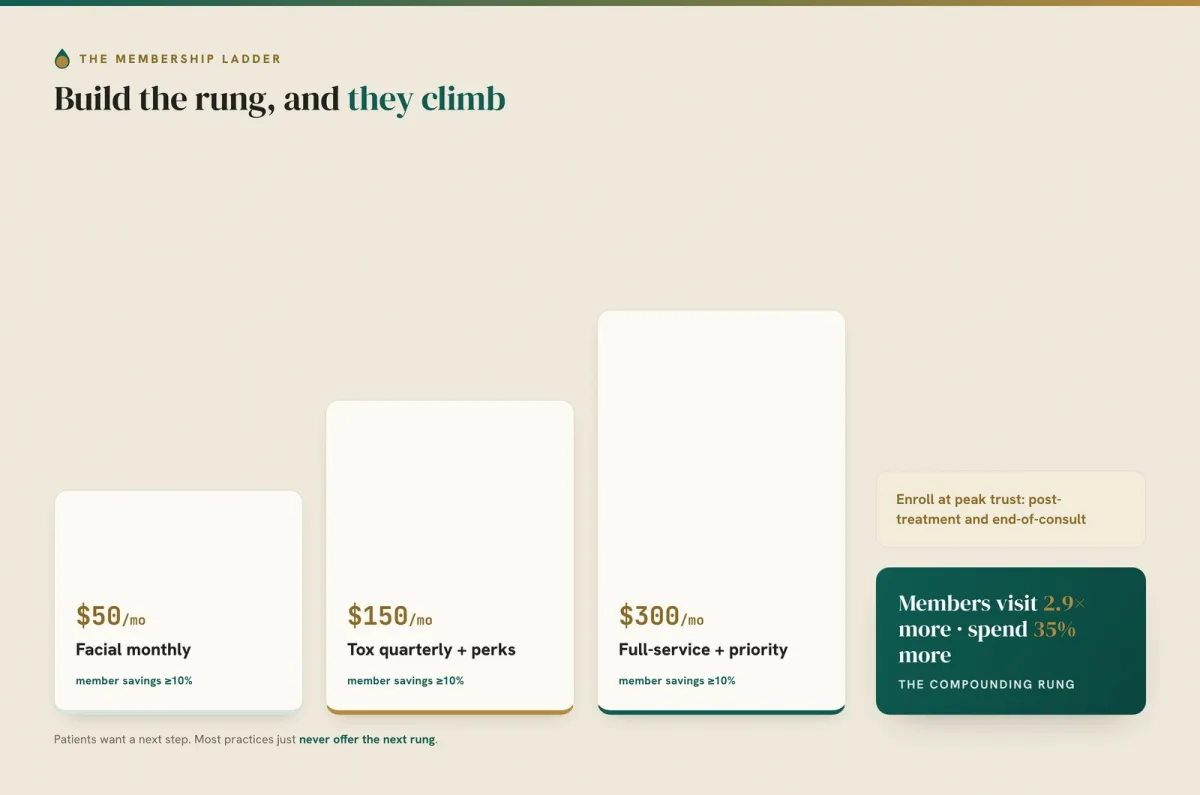
A progression trigger. At month 3 or month 6, the patient’s treatment plan is reviewed and an expanded bundle is offered. “Based on your results over the last 3 months, here’s what the next phase looks like.” This is where ARPU compounds. The patient who started at $149/month moves to $249/month because they’re ready for the next step — and you’ve defined what that step is.
How much should a med spa membership cost?
Pricing below $100/month almost always fails. It signals low value and attracts patients optimizing for cost, not outcomes. Those patients cancel fastest.
The practices that sustain membership growth price in three tiers:
| Tier | Monthly price | What’s included | Target patient |
|---|---|---|---|
| Essential | $149-$179/month | 1 core treatment + product credit | New patients, entry point |
| Premium | $229-$279/month | 2 treatments + cross-modality benefit | Established patients expanding goals |
| VIP | $349-$449/month | Full treatment bundle + priority access | High-value patients on comprehensive plans |
At 50 members averaging $199/month, your practice generates $9,950/month in predictable baseline revenue — $119,400 annually — before any additional treatments those members book. Membership patients spend 2-4x more annually than non-members because the membership creates the relationship that surfaces new needs. This is the recurring revenue engine that changes practice economics.
How do I get Botox patients to try fillers?
This is the cross-sell question that defines whether a membership program generates real ARPU growth or just discounts existing revenue.
The answer: you don’t sell fillers. You prescribe a treatment progression.
When a Botox patient has been on a 3-month membership cycle — receiving consistent injectable treatments — a provider-led conversation about complementary volume restoration isn’t a sales pitch. It’s a clinical recommendation. The framing matters enormously:
Sales framing (low conversion): “We also offer fillers. Would you like to add that to your next visit?”
Clinical framing (3-5x higher conversion): “Now that we’ve addressed the dynamic lines with your Botox regimen, there’s a volume component in your midface that targeted filler would address. Most patients at your stage see significantly better results when we combine both. Your membership includes a filler consultation — want me to walk you through the plan?”
The second approach positions the cross-sell as a logical next step in a treatment journey the patient has already committed to. The membership creates the context. The bundle creates the progression. The provider delivers the recommendation when the treatment plan says it’s time — not when they remember.
Practices with defined cross-sell moments at month 1, month 3, and month 6 see per-member ARPU increase by 40-60% within the first year. Practices that leave it to provider memory see flat ARPU and wonder why their 12 members aren’t generating meaningful revenue.
Why does enrollment stall after the first 12 members?
The first 8-15 members are easy — patients who already love your practice and would have said yes to almost anything. After that, enrollment stalls because the next 50 patients need to be convinced, not just offered. The convincing has to happen at a specific moment: right after a treatment delivers visible results.
60% of first-time patients never return for a second treatment. That’s not a membership problem — it’s a retention problem that a membership can solve. But only if the membership offer is positioned at the moment of peak satisfaction, not at intake when the patient hasn’t experienced results yet.
The enrollment timeline that works:
- First visit: Deliver the treatment. Don’t mention the membership.
- Results window (7-14 days post-treatment): Follow up. Confirm the patient is seeing results. This is the peak satisfaction moment.
- Second touch (14-21 days): Present the membership as the way to maintain and build on the results they’re already seeing. “You’re seeing great results from your first treatment. Here’s how we keep that momentum going — and add the next step in your treatment plan.”
- Enrollment point: The patient joins not because of a discount, but because they want to continue a result they’ve already experienced.
This sequence converts at 2-3x the rate of presenting the membership at intake or checkout. The patient has proof the treatment works. The membership is the mechanism for more of what they already want.
What if patients cancel after 3 months?
Early cancellation is the number one killer of membership programs, and it almost always traces back to one of three causes:
They forgot what they’re getting. The patient signed up, came in for month 1, skipped month 2, and by month 3 they’re paying $149 for something they didn’t use. The fix: book the next 3 appointments at enrollment, send treatment reminders, and track utilization monthly. Members who use their benefits cancel at one-third the rate of those who don’t.
The value plateaued. The patient got the same treatment three months in a row and doesn’t see incremental improvement. This is where the progression trigger matters. At month 3, the treatment plan should evolve — new modality, expanded bundle, visible next step. Stagnation kills memberships.
The cross-sell never happened. The patient was never introduced to the adjacent treatments that would deepen their commitment. A Botox-only member is fragile. A Botox-plus-facial-plus-skin-care member has three reasons to stay. Every additional treatment in the bundle increases retention by making the membership harder to replace.
How to rebuild a struggling membership program in 90 days
If your practice has fewer than 20 active members, here’s the rebuild:
Weeks 1-2: Audit. What’s the monthly churn rate? What percentage of members receive cross-modality treatments? If below 30%, the membership is functioning as a discount, not a treatment program.
Weeks 3-4: Restructure into bundles. Replace percentage discounts with specific included treatments. Create 2-3 tiers that reflect natural treatment progressions. Price the entry tier at $149-$179.
Weeks 5-8: Relaunch to existing patients. Present the restructured program at the results window (7-14 days post-treatment), not via mass email. Target patients who visited 2+ times in the last 6 months. Goal: 15-25 new members.
Weeks 9-12: Activate cross-sell triggers. Define the month-3 progression conversation. Train providers on clinical framing. Track per-member ARPU monthly.
By week 12, you should have 30-50 active members. At $199 average monthly, that’s $6,000-$10,000/month in predictable revenue — and cross-sell activity will add another 30-50% on top.
FAQ
How many members does a med spa need to make a membership program worthwhile?
Fifty members at $199/month generates $9,950/month in baseline revenue. But the real value isn’t the membership fee — it’s the 2-4x higher annual spend from members versus non-members. Even 30 members generating $199/month plus an additional $150/month in cross-sold treatments produces $10,470/month in total member revenue.
What’s the biggest mistake med spas make with membership programs?
Building the program around a discount instead of a treatment bundle. A 10% discount attracts price-sensitive patients who cancel quickly. A bundled treatment progression attracts outcome-oriented patients who stay and expand. The structure of the offer determines the quality of the member.
Should I offer a free trial or discount to get members to sign up?
No. Free trials and enrollment discounts attract patients optimizing for cost, and they cancel at 2-3x the rate of full-price members. Instead, offer the membership at the moment of peak satisfaction — after results are visible — when the patient is motivated by outcomes, not savings. The enrollment trigger should be results, not price.
How do I track whether my membership program is actually working?
Three metrics matter: monthly churn rate (target below 5%), per-member ARPU (should grow 20-40% in the first 6 months as cross-sells activate), and member utilization rate (what percentage of members used their included treatments this month — target above 80%). If utilization drops below 60%, cancellations will follow within 60 days.
Can a membership program work for a small practice with fewer than 200 active patients?
Yes — smaller practices often see faster membership growth because the provider-patient relationship is stronger. A practice with 100 active patients converting 30% to membership has 30 members generating $5,970/month at $199 average. The cross-sell opportunities those 30 recurring visits create each month compound quickly.
What treatments should be included in a med spa membership?
Start with your highest-frequency treatment — the one patients already need regularly (Botox, facials, skin maintenance). Then add a cross-modality benefit that introduces an adjacent service (fillers, skin resurfacing, body treatments). The core treatment creates visit cadence. The cross-modality benefit expands ARPU. Together, they create a treatment journey harder to cancel than a simple discount.
Written by Bill Eisenhauer, Founder of Alchemy Inside. We help cash-pay med spa practices recover the revenue already inside their patient base.
Revenue & Growth
How much revenue is slipping through your follow-up gaps?
This article explored one category. The free diagnostic scores all six — and gives you a dollar estimate in 90 seconds.
Take the Free Diagnostic