The Deep Work Protocol: The One Hour a Week an Owner-Injector Should Protect
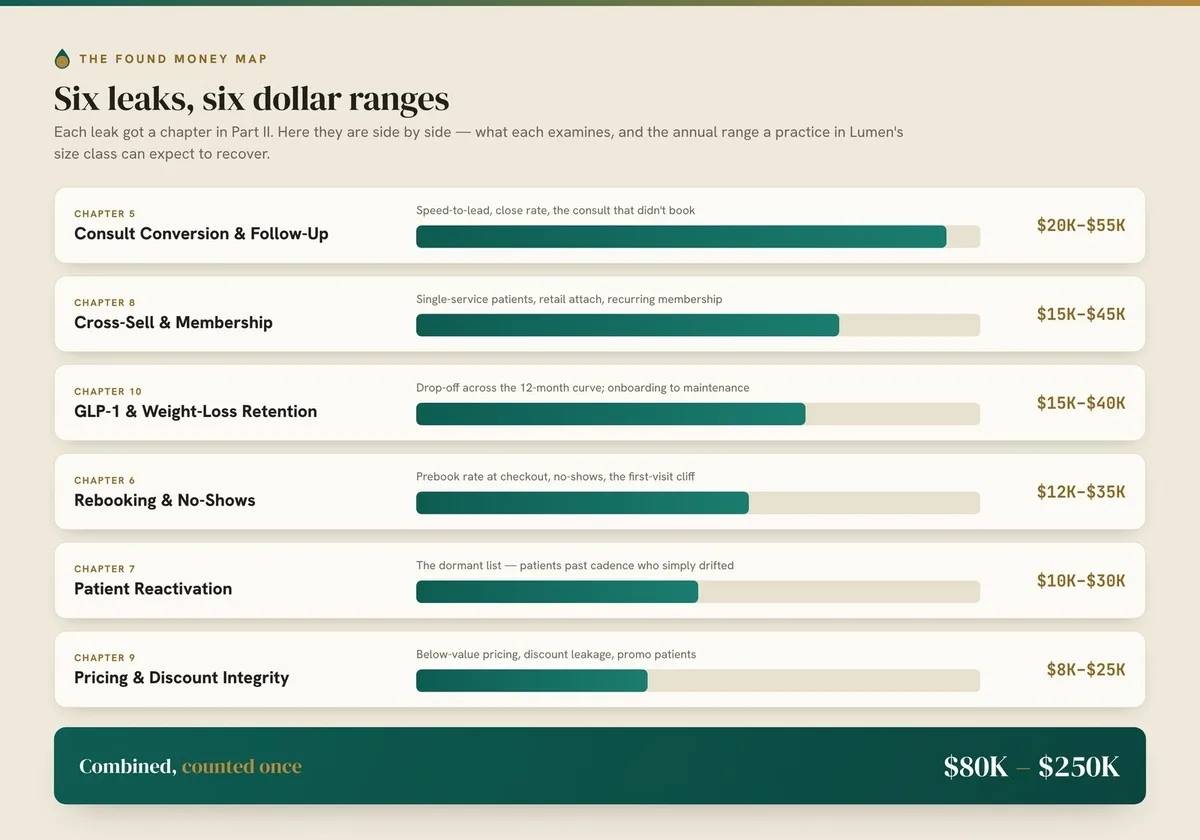
A full book leaves the owner-injector no time to read the numbers, and that's where an estimated $80,000–$250,000 a year hides. One protected hour a week and five numbers find it.

Bill Eisenhauer
July 02, 2026 · 8 min read
Most owner-injectors spend every working hour in the chair or answering the front desk, which leaves zero hours for the work that finds money. That’s expensive. A practice the size of the example in The Med Spa Money Map carries an estimated $80,000 to $250,000 a year in recoverable revenue from patients it already has, and none of it shows up on a full schedule. The fix isn’t a longer week. It’s one protected hour a week with five numbers, plus a front desk that doesn’t need you mid-treatment.
At a glance
- An estimated $80,000–$250,000 a year is recoverable in a typical cash-pay aesthetic practice, and it only shows up in the numbers, not on the schedule
- Five numbers in one weekly hour: prebook rate, no-show rate, unanswered inquiries, the overdue list and membership share
- Busy isn’t productive: a provider who sees 8 patients and produces $4,000 outperforms one who sees 12 and produces $3,000
- Most chair interruptions are decisions the desk could make with a price sheet and a written policy
Key takeaways
- The owner-injector is usually the practice’s scarcest hour, and it’s spent on the lowest-value work. Price questions, discount approvals and “can you look at this schedule” pull you out of treatments, while nobody reads the numbers that show where patients are leaking.
- One protected hour a week beats a vague plan to “work on the practice.” Put it on the calendar like a patient, same day and time, and treat a cancellation of it the way you’d treat a no-show.
- The overdue list is the fastest money that hour will find. A single PMS query (patients past their treatment cadence with nothing booked) usually turns up the cheapest revenue in the building.
- Check this week: can you state your prebook rate, no-show rate and provider utilization right now, without looking? If not, that’s the first thing the protected hour fixes.
- Take the free diagnostic → It tells you which of the six leaks your practice should spend that hour on first.
Where does an owner-injector’s week actually go?
Picture a Tuesday at 2:00. You’re between a filler patient and a tox touch-up. The coordinator catches you in the hall: a new patient wants to know what lip filler costs, a regular wants her membership discount applied to a HydraFacial, and there’s a voicemail from someone asking about GLP-1. You answer two, push one to “later,” and walk into the next room four minutes behind.
Nothing about that afternoon feels like a problem. The schedule is full. That’s the trap the book calls busy hides the leak: a full schedule measures activity, not what the practice keeps. The GLP-1 voicemail waits until tomorrow, and 74% of practices already miss the five-minute window for new inquiries. The regular who asked about her membership is one of a handful of members, because membership sits under 10% of revenue at most independents, against 20–30% at healthy ones. And nobody noticed that the tox patient who used to come every fourteen weeks hasn’t been in for seven months.
You’re not short on effort. You’re short on one uninterrupted hour to look.
Why is the owner’s hour the most expensive one in the building?
Because in most practices the owner is both the top-producing injector and the only person who can make pricing, staffing and follow-up decisions. Every hour she spends on work the desk could do comes out of one of those two jobs.
Put a rough number on it. If your chair hour produces somewhere around $600–$1,200 (illustrative: one to two injectable visits at the industry’s $300–$600 average ticket), a week of hallway decisions that adds up to three hours costs roughly 3 hours × $600–$1,200 = $1,800–$3,600/week in chair time (estimate). That’s before counting the decisions that got made badly because they were made in a hallway.
Busy also hides which hours are worth the most. Liguori Accounting’s comparison makes the point: a provider who sees 8 patients and produces $4,000 outperforms one who sees 12 and produces $3,000. The schedule shows the second provider as busier. The revenue-per-hour number shows who’s actually carrying the practice. Two related benchmarks from the same work: it’s time to hire when utilization runs 75–80%, and payroll should run 25–35% of revenue, counting the owner’s own pay, which owners often leave out. You can’t see any of those three numbers from the treatment room.
What goes in the protected hour?
Five numbers, pulled from your PMS the same way every week, compared with last week.
| Number | Leaking | Healthy | What it points to |
|---|---|---|---|
| Prebook rate (checkouts leaving with a next visit booked) | 40% or below | 50%+ | The rebooking gap |
| No-show rate | 12–20% | Under 10% | Deposits and reminders |
| New inquiries without a reply inside five minutes | Most of them | Almost none | Consult follow-up |
| Patients past their treatment cadence with nothing booked | A list nobody opens | Worked every week | Reactivation |
| Membership share of revenue | Under 10% | 20–30% | Cross-sell and membership |
The fourth line is where the hour pays for itself fastest. At Lumen Aesthetics, the book’s example practice, roughly 800 patients were overdue for a treatment they’d already had. A first campaign that brings back a conservative 15% of them is worth about 800 × 0.15 × $3,000 = $360,000 in lifetime value (estimate). That list sits in the PMS of almost every practice, and it’s the heart of patient reactivation. Pulling it takes one query. Working it takes a coordinator with a script. Neither happens if nobody ever sits down to look.
Don’t try to fix five things. Pick the one number furthest from healthy, decide the one change the desk will make this week, and check it next week.
How do you keep the desk from pulling you out of the chair?
Most interruptions are decisions without a rule. Write the rule once and the question stops coming to you.
A price sheet the desk can quote from. Starting prices or ranges for your top treatments, approved by you. When a new patient asks what lip filler costs, the coordinator asks what they’re hoping for, then gives the starting range. Refusing to quote reads as hiding; a bare unit price invites shopping. Neither needs you.
A written discount policy. Who gets what, and nothing else. Exceptions wait for the protected hour, not the hallway.
Two huddles, not twenty interruptions. Ten minutes before the first patient and ten minutes after lunch, the desk brings everything that genuinely needs you. Anything clinical or urgent still comes straight in; everything else waits for the huddle.
An inquiry owner. Speed-to-lead is the desk’s job, not yours. Name the person who answers new inquiries within five minutes, and an instant acknowledgment for after hours, so a GLP-1 voicemail isn’t waiting for you to finish a treatment.
What does the first month look like?
Week 1: Book the hour. Same day and time every week, on the calendar as a blocked appointment. Pull the five numbers once, even roughly. Write the price sheet.
Week 2: Install the huddles. Tell the desk what now waits for the huddle and what still comes straight in. Write the discount policy.
Week 3: Work the overdue list. Pull patients past cadence with nothing booked, starting with those overdue by the smallest margin. The coordinator reaches out with two concrete times.
Week 4: Compare. Same five numbers against week one. Keep the hour. Move one more interruption into a written rule.
What does AI actually do for the owner’s protected hour?
The first step isn’t AI at all. Most PMS platforms can already produce a prebook report, a no-show report and a list of patients by last visit date; set them to run weekly so the numbers are waiting when the hour starts.
AI is useful where the hour runs out of attention. Reading 2,400 patient histories against each one’s own cadence to decide who is actually overdue, versus who just had a longer gap than usual, is pattern-matching nobody on staff has time for. So is noticing that one provider’s prebook rate slipped while the practice average held. The book’s version is a fifteen-minute morning briefing: two decisions only the owner can make, three patients worth a call today and the dollars at stake. The protected hour doesn’t go away. It just starts with the finding already done instead of the report still to pull.
FAQ
How much time should a med spa owner spend on the numbers each week?
One protected hour is enough to start, as long as it’s the same hour every week and the numbers come from the PMS rather than memory. Owners who can’t state their prebook rate, no-show rate and utilization off the top of their head are running the practice without instruments.
What KPIs should a med spa owner review weekly?
Start with five: prebook rate, no-show rate, how many new inquiries got a reply inside five minutes, the number of patients past their treatment cadence with nothing booked, and membership share of revenue. Add utilization and revenue per provider-hour once those five are routine.
How do I stop the front desk from interrupting me during treatments?
Turn repeated questions into written rules: an approved price sheet, a discount policy and a named owner for new inquiries. Then give the desk two short daily huddles for anything else. Clinical and urgent questions still come straight in.
When should an owner-injector hire another provider?
A common benchmark is 75–80% utilization: when booked hours run at that share of available hours, it’s time to hire. Below that, the better move is usually filling the chair you have by fixing rebooking and no-shows first.
Is revenue per provider-hour more useful than number of patients seen?
Yes. Two providers can look equally busy and produce very different revenue depending on treatment mix, discounting and rebooking. Revenue per provider-hour shows which schedule is actually carrying the practice.
A note on these figures: the $80,000–$250,000 range and the $360,000 reactivation figure come from the book’s example practice with a conservative $3,000 lifetime value; the reactivation number is lifetime value, not one year’s cash, and overlaps with rebooking recovery, so count it once. The prebook, no-show, speed-to-lead, membership, utilization and payroll figures are industry benchmarks. The chair-hour range and the Tuesday scenario are illustrative. Confirm everything against your own PMS and accounting data.
Written by Bill Eisenhauer, Founder of Alchemy Inside.
Workflow & Automation
How many hours is your team losing to manual work?
This article explored one category. The free diagnostic scores all six — and gives you a dollar estimate in 90 seconds.
Take the Free Diagnostic