The Reactive Leadership Tax: What the Slow-Month Discount Really Costs Your Practice
A slow month tempts owners into a flash sale or a new device. 73% of discount patients never return at full price. The overdue list in your PMS is usually worth more, an estimated $360,000.

Bill Eisenhauer
July 29, 2026 · 9 min read
The most expensive decisions in a med spa are usually made in the slowest week of a slow month: run a flash sale, blast a discount, sign for the new device. They feel like action. They’re usually a tax. 73% of patients acquired on a discount never return at full price, and a discount run in a panic tends to become the price. The calmer move is almost always sitting in your PMS already. At the example practice in The Med Spa Money Map, about 800 patients were overdue for a treatment they’d already had, worth an estimated 800 × 0.15 × $3,000 = $360,000 in lifetime value.
At a glance
- 73% of discount patients never return at full price, so a slow-month promotion buys visits, not patients
- About 22% of med spa appointments already use a promo discount, and 68% of owners say discounting has hurt their positioning
- An estimated $360,000 in lifetime value sits in a typical practice’s overdue list, recoverable without cutting a price
- A written slow-month rule (check three numbers before any promotion, device or hire) stops most reactive decisions before they cost anything
Key takeaways
- Slow months are usually a retention problem that looks like a demand problem. The chairs are empty because patients who were due didn’t come back, not because the market dried up. A discount aimed at new patients treats the wrong thing.
- Reactive discounts are hard to undo. Patients remember the sale price, the desk learns that exceptions are normal and the deal-seekers you attracted wait for the next one.
- Big reactive purchases carry long tails. A device bought to “bring in new patients” in a slow quarter can take a year or more to pay back, and the monthly payment arrives whether or not the bookings do.
- Check this before your next promotion: pull the number of patients who are past their treatment cadence with nothing booked. If that list is longer than the number of new patients the promotion would need to bring in, work the list first.
- Take the free diagnostic → It shows whether pricing and discounts are one of the leaks costing your practice the most.
What does a reactive decision look like in a med spa?
It’s the first week of March. January and February were soft, the schedule has gaps on Tuesdays and Thursdays, and the owner-injector is looking at a month that will come in under last year. A rep for a new body-contouring device happens to call. A competitor posts a tox special. By Friday, the owner has approved a “spring refresh” promotion (20% off neuromodulator for new patients) and is reading financing terms on the device.
None of it is irrational. Each decision answers the visible problem: empty chairs, a scary month. But none of them asks why the chairs were empty. And the answer in most practices is on a report nobody opened: the prebook rate slipped under 40%, so the patients who came in over the holidays left without a next visit. The tox patients who were due in February didn’t get a reminder. They didn’t leave for the competitor. Nobody called them.
That’s the reactive leadership tax. The owner pays for a fix to a problem the practice doesn’t have, while the real one keeps leaking.
What does a slow-month discount actually cost?
More than the discount, and for longer than the month. Take an illustrative flash sale: 40 new patients come in for neuromodulator at 20% off a $400 ticket.
40 patients × $400 × 0.20 = $3,200 given up in the month (estimate)
That’s the small part. The bigger cost is who you bought. If 73% of discount patients never return at full price, roughly 29 of those 40 are one-time visits, each acquired at full marketing cost. The remaining 11 are now anchored to the sale price. And the practice’s regulars saw the ad too; some of them will ask the desk for the same deal next visit. About 22% of med spa appointments already carry a promo discount, and more than two-thirds of owners say discounting has hurt how their practice is seen. A panic discount usually adds to both numbers.
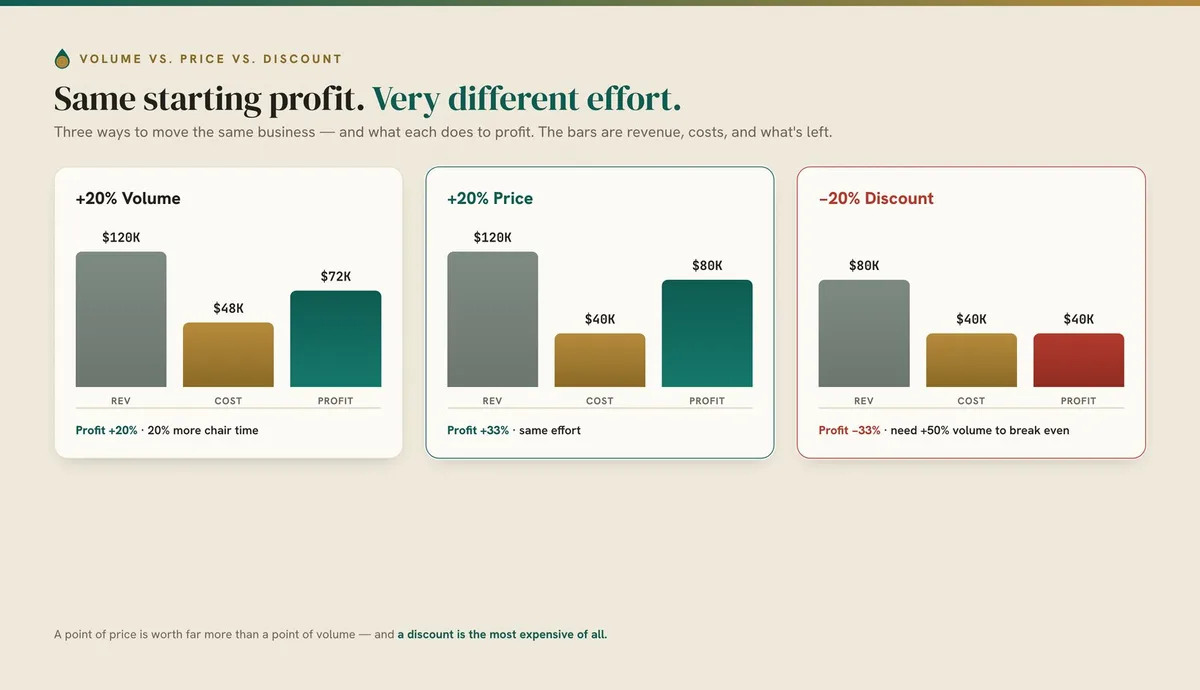
This is pricing and discount integrity, and it’s rarely a pricing decision anyone made on purpose. It’s a stack of slow-month reactions. At Lumen Aesthetics, the book’s example practice, prices hadn’t moved in two years even as product costs climbed, while promotions kept quietly lowering what patients actually paid. There’s a longer treatment in what discounting really costs.
Why do reactive decisions keep winning?
Because the numbers that would slow them down aren’t in front of the owner when the decision gets made. Most owners make spending decisions on gut feel against revenue that looks healthier than it is, because the booking system and the accounting never connect. In that fog, “run a sale” feels like the only lever.
Three reactive decisions show up again and again:
| The reflex | What it costs | The question it skips |
|---|---|---|
| A flash sale or deal-site offer | Margin now, full-price patients later | Were the empty slots caused by missing new patients, or missing returning ones? |
| A new device to “bring in new patients” | A fixed payment against thin bookings; payback can run a year or more | Is there demonstrated, unmet demand from patients you already have? |
| A promotion priced without knowing procedure cost | Some promotions lose money on every visit | What does this treatment cost in product, consumables and provider pay? |
Each one gets decided in an afternoon and paid for over a year. The fix isn’t more willpower. It’s a rule that puts three numbers in front of you before you decide.
What’s the calmer move when a month is slow?
Look inward first. Almost every slow month traces back to one of three places, and all three are cheaper to fix than acquiring new patients: roughly $20–$60 to reactivate a patient you already have, against $100 or more to bring in a new one.
The overdue list. Patients past their treatment cadence with nothing booked. At Lumen that was about 800 people. A conservative 15% response is the $360,000 in lifetime value above; even a 10% first campaign is roughly 800 × 0.10 × $3,000 = $240,000 (estimate). See the reactivation playbook for how to work it.
The prebook rate. If fewer than 40% of last quarter’s patients left with their next visit booked, the slow month was scheduled months ago. Fixing it now fills next quarter.
Unworked consults. Consults that didn’t book on the spot and never got a follow-up. They already cost you the marketing; a structured follow-up converts a real share of them.
Count these once. They share a root cause (no closed loop on treatment cadence), so a patient reactivated from the overdue list isn’t also a rebooking win.
How do you build a slow-month rule?
Write it before the next slow month, while you’re calm.
Rule 1: No promotion, device or hire decision on the day it comes up. Write it down, sleep on it and decide at your next weekly numbers review.
Rule 2: Check three numbers first. Prebook rate for the last 90 days, the size of the overdue list and the no-show rate. If any is in the leaking range (prebook at 40% or below, no-shows at 12–20%), fix that before spending on acquisition.
Rule 3: Know the floor. Keep a one-page cost sheet for your top treatments (product, consumables and provider pay). No promotion goes out that comes close to it.
Rule 4: Stack value instead of cutting price. When you do need a reason for patients to act, add something (the maintenance product, a follow-up check) rather than cutting the price. The ticket holds and the patient still feels they won.
Rule 5: Say the decision out loud to one person. Your practice manager, your medical director or a peer owner. “I’m about to run 20% off tox because March is slow. What am I missing?” One outside question catches most of what a bad week hides.
What does AI actually do for slow-month decisions?
The numbers in Rule 2 are reports your PMS can already run; scheduling them weekly is a setting, not AI.
Where AI helps is the moment of decision itself. When the owner is about to approve a promotion, a system that has read the practice’s full history can put the context on one page in minutes: how many patients are overdue by treatment, what the last three promotions actually returned in full-price visits, what this treatment costs to deliver and what a realistic device payback looks like on your own booking data. That’s the analysis a stressed owner skips. The decision stays the owner’s. It just gets made with the overdue list on the table instead of the competitor’s ad.
FAQ
Should a med spa run promotions when the schedule is slow?
Look at your own patients first. Slow months usually come from patients who were due and didn’t return, which a reactivation campaign fixes without cutting price. If you do run a promotion, price it above your cost floor and add value rather than discounting.
Do discount patients come back at full price?
Mostly not. By industry figures, 73% of patients acquired on a discount never return at full price. That makes discounts an expensive way to fill chairs and a poor way to build a patient base.
How do I know if a new device will pay off?
Buy on demonstrated, unmet demand from patients you already have, and model payback on realistic bookings rather than the rep’s projection. Payback on aesthetic devices can run a year or more, and the payment starts before the bookings do.
What should I do first when revenue drops?
Pull three numbers: prebook rate for the last 90 days, the number of patients past their treatment cadence with nothing booked and your no-show rate. The one furthest from healthy usually explains the drop better than market conditions do.
How do I stop making decisions I regret?
Make a rule that no promotion, device or hiring decision gets made on the day it comes up, and require the three numbers above before any of them. Run the decision past one other person. Structure does more than willpower here.
A note on these figures: the discount statistics (73%, about 22% and 68%) are industry figures. The $360,000 and $240,000 reactivation figures are illustrative math on the book’s example practice with a conservative $3,000 lifetime value; they’re lifetime value, not one year’s cash, and overlap with rebooking recovery, so count them once. The flash-sale math, the $400 ticket and the March scenario are illustrative. Confirm against your own PMS and accounting data. Chapter 9 of The Med Spa Money Map covers pricing and discount integrity in full.
Written by Bill Eisenhauer, Founder of Alchemy Inside.
Revenue & Growth
How much revenue is slipping through your follow-up gaps?
This article explored one category. The free diagnostic scores all six — and gives you a dollar estimate in 90 seconds.
Take the Free Diagnostic