The discount that quietly became your price.
Your answers suggest prices get reviewed when something forces it, and discounts go to whoever asks or returns. Here's what that usually costs, a better routine, and how to check it this week.
The two questions behind this score
- 1. When did you last check that your prices and packages still leave enough profit after product and provider pay?
- 2. Do you give a standing discount, like 10% off for returning patients or anyone who asks?
Why a full schedule hides it
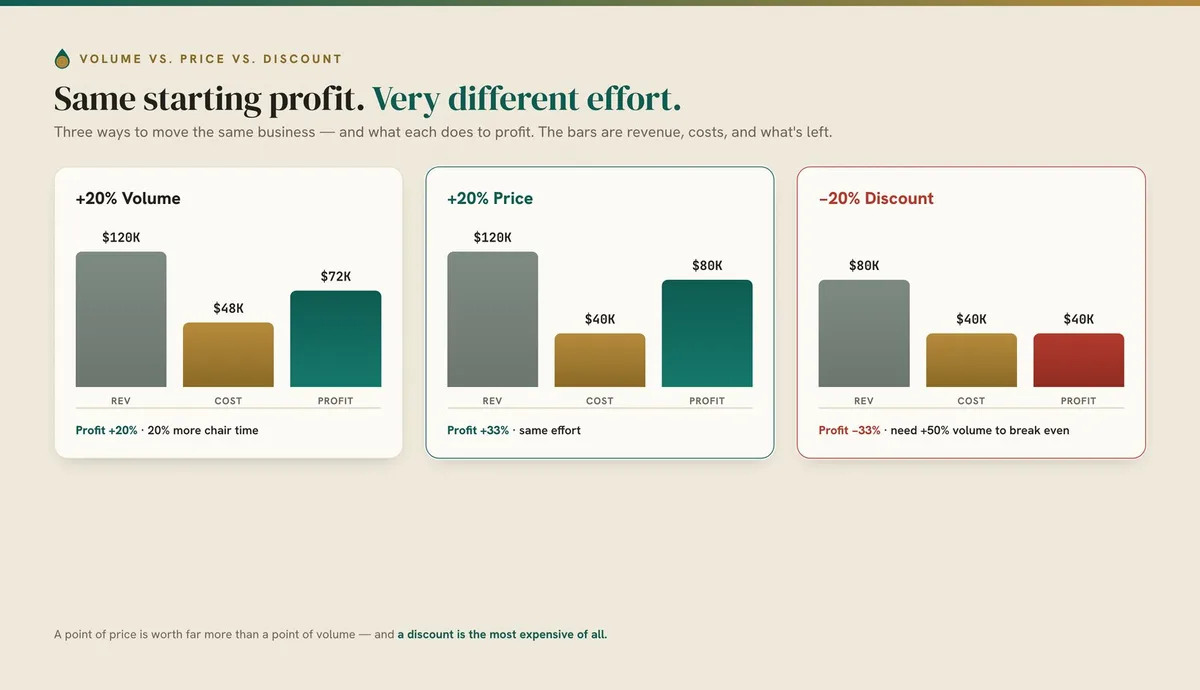
Discounts fill the calendar, so the practice feels healthy. What doesn’t show up on the schedule is margin. Revenue can grow while profit stays flat, and that’s the classic sign of pricing that hasn’t kept up with costs.
The math is also less forgiving than it looks. A discount comes straight off revenue while product, provider time and overhead stay where they were. In the discounting article I work through a practice with 55% gross margins: a 20% discount takes 36% of its gross profit, not 20%.
What your answers usually mean
If prices mostly get looked at when a cost goes up or a promotion flops, or you match competitors and keep what you’ve always charged, your rates were probably set early, when you had the least information, and haven’t moved since.
If a flat discount goes to anyone who comes back or asks, it’s no longer a promotion. It’s your real price for your best patients, the ones who’d have come back anyway.
What most practices do, and a better routine
Most practices treat price pushback as a price problem and cut the number. Usually it’s a value problem: the consult didn’t make the expected outcome clear.
A better routine:
- Right-size instead of discounting. “I can adjust the treatment plan to fit that budget. Here’s what that looks like.” Fewer units or one area, same rate.
- Reward commitment rather than asking. A membership that trades a modest per-visit benefit for recurring visits is a different thing from 10% off for anyone.
- Review what you actually collect, not what the menu says, at least quarterly.
- Revisit rates on a schedule. In You’re Probably Undercharging I cover the pricing data showing 10% to 20% increases in cash-pay aesthetics typically cost only 1% to 3% of patients.
One number to check this week
Pick your three highest-volume treatments. From your point-of-sale or booking system, pull the last 90 days and compare the average price you actually collected to your published price.
If the average is more than 10% below the menu, discounting is probably eating into your margins, even if nobody decided it should.
Napkin math
(Published price − average price actually collected) × number of those treatments in a year
Do it for each of the three treatments and add them up. Nearly all of that number would have been profit, because the cost of doing the treatment didn’t change. It’s an estimate, and it assumes every discounted patient would have paid full price, which some wouldn’t. Knock it down by whatever share you think would have walked, and you still have a number worth knowing.
Want the real number for your practice?
The math above is a napkin estimate. The Found Money Audit works it out from your own numbers, across all six areas, and ranks what to fix first. If you'd rather talk first, grab 15 minutes and we'll look at whether it's worth doing.
There is no pricing install and there isn't going to be one. What you charge depends on your costs, your market and your margin — so this one goes to the audit, or to your own advisor.
Start here
Book a free 15-minute call
We'll talk about this and whether the audit makes sense for you
Free · No commitment
Or go direct
Found Money Audit
If I don't find $10K+ a year in recoverable revenue, it's free
$497
Haven't taken the Free Practice Diagnostic, or want to run it again? Take it now, about 90 seconds →
The other five leaks
A leak is money from patients you already have that slips away without anyone deciding it should.
All six leaks →