The second service nobody mentioned.
Your answers suggest patients hear about the product, treatment or membership that fits them only when someone remembers, and nobody knows how many buy more than one thing. Here's what that usually costs, a better routine, and how to check it this week.
The two questions behind this score
- 1. When a patient comes in for one treatment, do they hear about the product, treatment or membership that fits them next?
- 2. Out of every ten patients, how many buy more than one thing from you: a second treatment, a product, or a membership?
Why a full schedule hides it
Every patient on your calendar is paying for something, so the day looks productive. What doesn’t show up anywhere is the product they’d have bought, the treatment that would have complemented the one they came in for, or the membership that would have brought them back monthly instead of twice a year. A sale that never gets offered leaves no trace.
What your answers usually mean
If the next recommendation happens “when the provider thinks of it,” it happens on slow days and not on busy ones. If you have a membership most patients don’t know about, it’s not really being offered. And if nobody knows how many patients buy more than one thing, there’s no way to tell whether any of it is working.
Patients are usually waiting to be told. PatientNow’s figure, which I cover in the skincare article, is that 86% of patients expect a skincare recommendation before treatment and only 14% get one. Usually the problem isn’t the patient saying no. Nobody asked.
What most practices do, and a better routine
Most practices respond to weak retail by ordering more products, and to a slow membership by adding a bigger discount. Both make it worse. More SKUs make the recommendation harder to give, and a discount-only membership gets cancelled once patients do the math.
A better routine:
- One product per clinical purpose, not per brand, so anyone on the team can name the right one in ten seconds.
- Each treatment paired with the one product that supports it, and the provider says why during the treatment, not at the register.
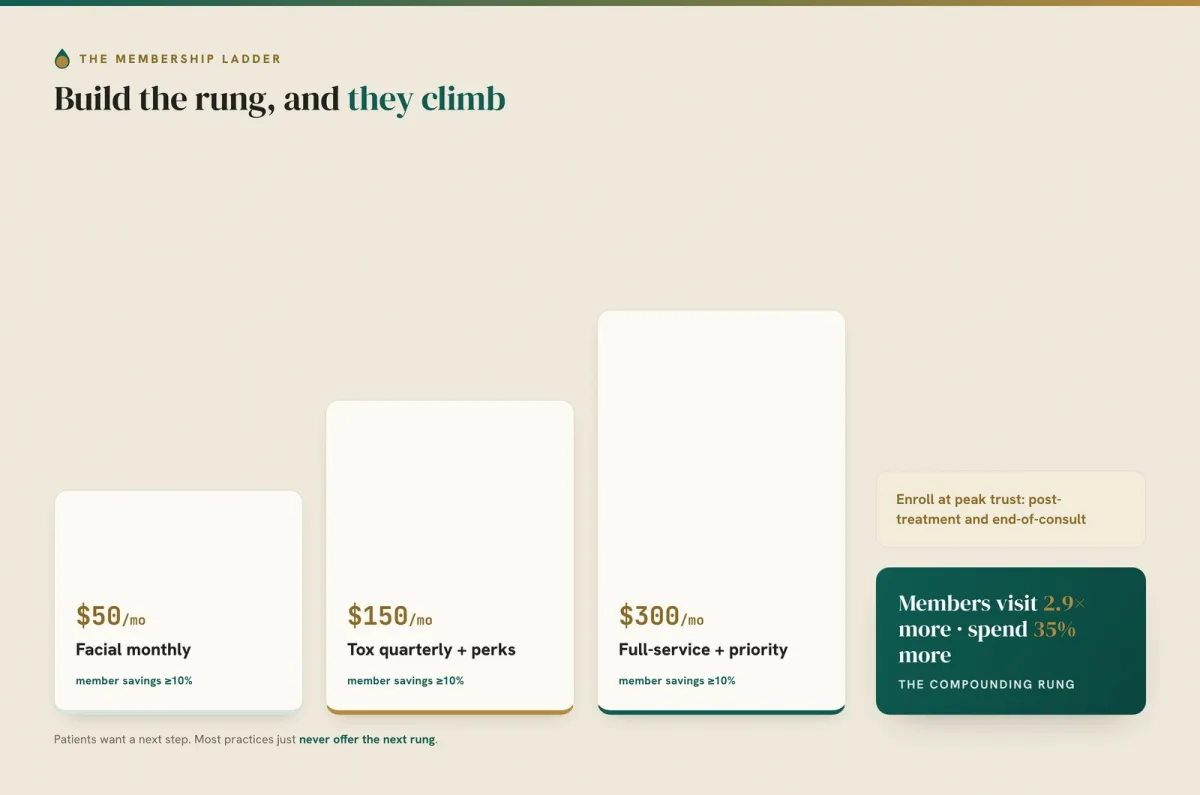
- A membership built as a treatment plan: a core monthly treatment, a benefit that introduces an adjacent service, and a planned next step at month three or six.
- The membership offered 7 to 14 days after treatment, when the patient can see results, rather than at intake.
In The Membership Program Problem I go through why membership patients spend two to four times more a year, but only when the program is structured this way.
One number to check this week
From your booking or point-of-sale system, take last month’s patients. Count how many bought more than one thing: a second service, a product, or a membership. Divide by the total. That’s the share of patients buying more than one thing. While you’re in there, pull retail revenue as a percentage of service revenue.
Napkin math
(Your target retail % − your current retail %) × annual service revenue × your retail margin
A useful working target for most independent practices is 10% to 15% of service revenue; the industry average is 3% to 5%. Start with 10% and your real margin. That’s an estimate of product alone, before memberships or second services, so it’s the conservative end.
Or have it installed.
Everything above is yours to build, and plenty of practices do. If you'd rather it was running by the end of the month, this is the install that closes it — fixed price, a named number, and a report at day 60 comparing it against where you started.
Not sure yet
Book a free 15-minute call
We'll talk about this and whether an install is worth it for you
Free · No commitment
Or size it first
Found Money Audit
Your own numbers, across all six areas, ranked by what to fix first
$497
Haven't taken the Free Practice Diagnostic, or want to run it again? Take it now, about 90 seconds →
The other five leaks
A leak is money from patients you already have that slips away without anyone deciding it should.
All six leaks →