The inquiries that got one reply, or none.
Your answers suggest new inquiries wait for whoever's free, and consults that don't book on the spot mostly don't hear from you again. Here's what that usually costs, a better routine, and how to check it this week.
The two questions behind this score
- 1. When someone calls, texts or fills out your website form asking about a treatment, how fast do they hear back?
- 2. When someone comes in for a consult and doesn't book a treatment, what happens next?
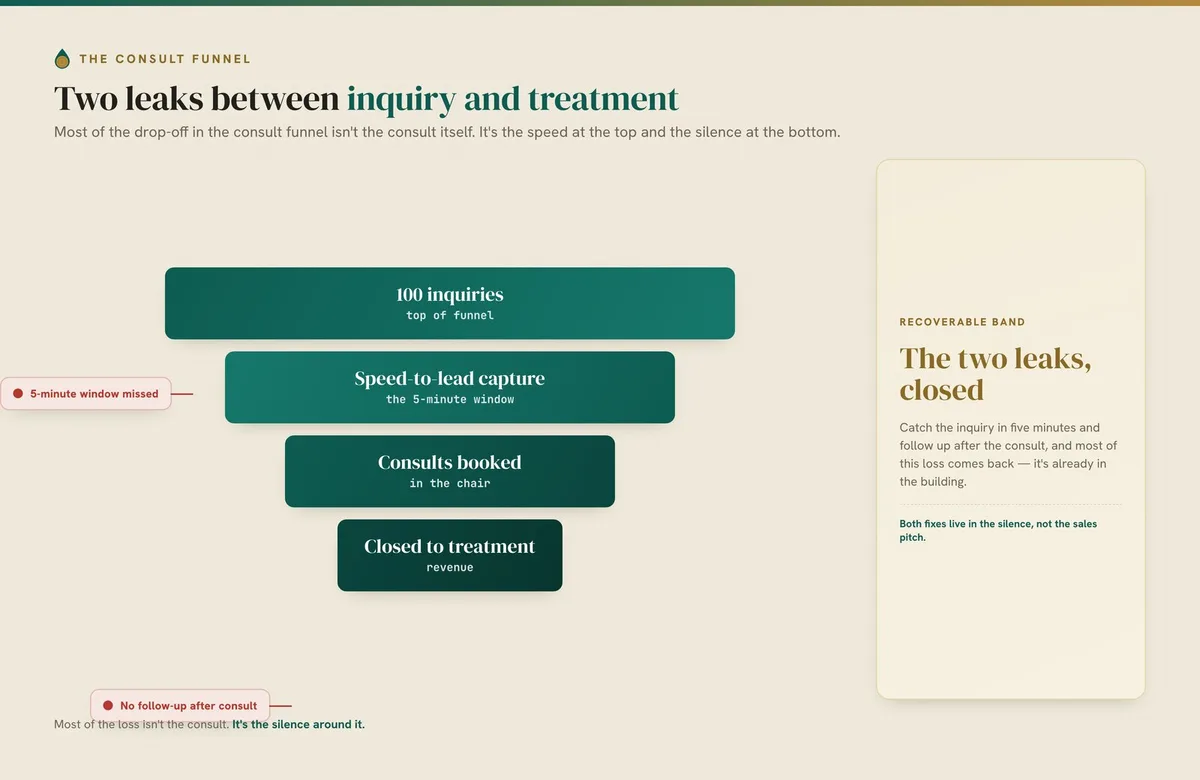
Why a full schedule hides it
Your calendar is made of the people who booked. The ones who didn’t never show up anywhere. They don’t complain and they don’t cancel. They filled out your form on a Tuesday, heard nothing until Thursday, and booked with whoever answered first.
When the front desk is juggling check-ins and the phone, the inquiry inbox is the first thing to wait. That’s why this leak is so common in busy practices: the busier you are, the slower the reply.
What your answers usually mean
If a new inquiry gets a reply “within a few hours” or “a day or two,” you’re answering after the moment has passed. As I cover in The 5-Minute Follow-Up Rule, response delays beyond five minutes cut the odds of converting an inquiry by more than 80%.
If a consult that doesn’t book gets one follow-up, or “we follow up if we remember,” the people still deciding are left alone. Some patients take 60 to 180 days to commit. Without anything that keeps you in touch, they decide somewhere else.
What most practices do, and a better routine
Most practices tell the team to “be better about following up.” That doesn’t change anything, because nobody at the front desk has slack to chase dozens of unbooked inquiries by hand.
A better routine:
- An automatic first reply within a minute, from a named person, offering two specific consult times. Not “we received your inquiry.”
- A human follow-up after that, with the context already in hand.
- A short sequence for anyone who doesn’t book: a text on day 1, an email on day 3, another text on day 10.
- A monthly check-in for the slow deciders, useful rather than “just circling back.”
The research I cite in The Follow-Up Gap puts the recovery at 5% to 20% of “lost” prospective patients once structured follow-up is in place.
One number to check this week
Pull the last 90 days of consult inquiries from your booking system. Count how many got a second touch. Then pick the last ten and check how long each one waited for its first reply.
It takes about 15 minutes. Most owners are surprised by at least one of the two numbers.
Napkin math
Unbooked inquiries per month × 12 × your average first-visit value × 5%
Five percent is the bottom of the recovery range, so treat the result as a conservative estimate, not a promise. It also leaves out everything a recovered patient spends after the first visit. For scale, the article’s example (60 inquiries a month, $800 first visit, 30% booking) comes to about $19,200 a year at 5%.
Or have it installed.
Everything above is yours to build, and plenty of practices do. If you'd rather it was running by the end of the month, this is the install that closes it — fixed price, a named number, and a report at day 60 comparing it against where you started.
The install covers the inquiry that waits. The consult who came in and didn't book is real, and I don't sell an install for it yet — that one starts as a conversation.
Not sure yet
Book a free 15-minute call
We'll talk about this and whether an install is worth it for you
Free · No commitment
Or size it first
Found Money Audit
Your own numbers, across all six areas, ranked by what to fix first
$497
Haven't taken the Free Practice Diagnostic, or want to run it again? Take it now, about 90 seconds →
The other five leaks
A leak is money from patients you already have that slips away without anyone deciding it should.
All six leaks →