The patients who stop halfway, without telling you.
Your answers suggest that when a patient is due back and hasn't booked, or finishes a series or program, it isn't anyone's job to notice. Here's what that usually costs, what a better routine looks like, and how to check your own numbers this week.
The two questions behind this score
-
1.
When a patient is due back (tox at three or four months, the next session in a series) and hasn't booked, what happens?
GLP-1 practices saw: When a GLP-1 patient misses a monthly refill, what happens? -
2.
When a patient finishes a treatment series, do they leave with a next step?
GLP-1 practices saw: When a GLP-1 patient stops the medication, do they leave with a next step?
Why a full schedule hides it
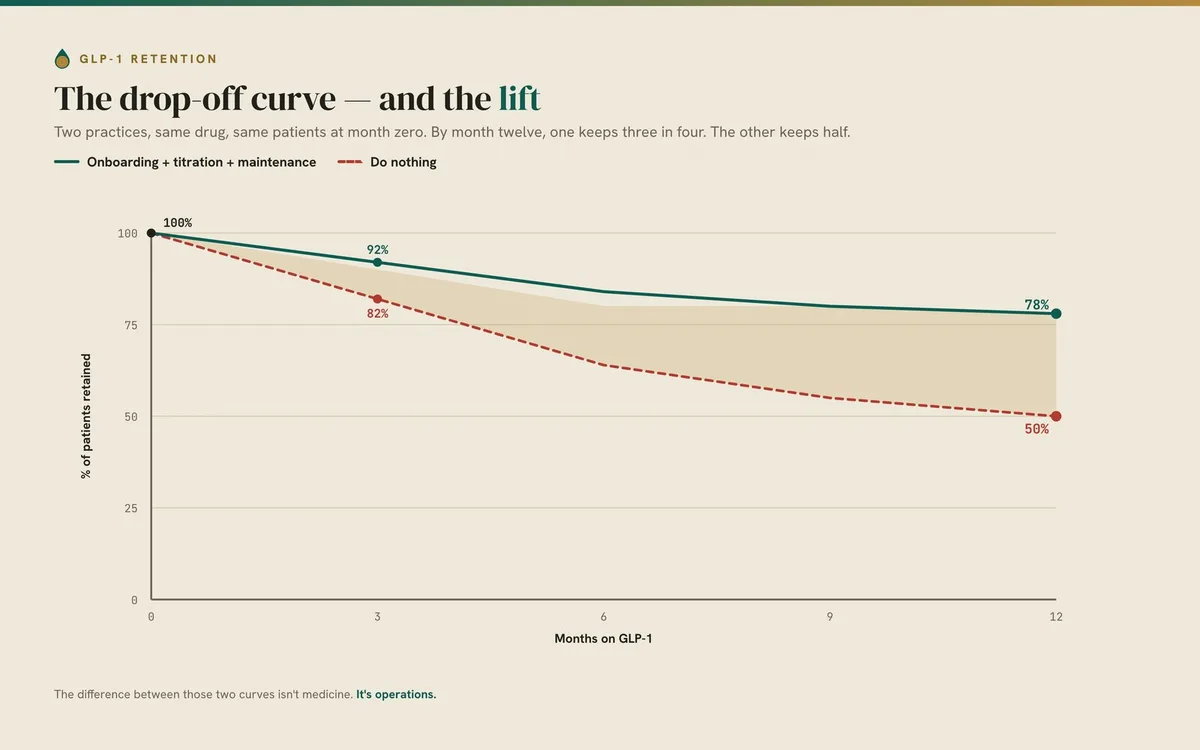
A patient who drifts doesn’t cancel anything. The tox patient who was due in April just doesn’t book. The GLP-1 patient doesn’t reorder. The series patient skips session three and never books session four. There’s no empty chair to look at, and new starts keep filling the calendar, so the practice feels busy while the back half of every program thins out.
For GLP-1 programs the scale of it is published, and I go through it in The GLP-1 Retention Cliff. A 2025 retrospective cohort of 125,474 adults found that 64.8% of patients without type 2 diabetes stopped GLP-1 therapy within a year. The exits cluster in three windows: month one (side effects), months three and four (stalled progress), and months six through nine (“I hit my goal,” or cost fatigue). Multi-session series show the same shape, as I cover in The No-Show Tax: patients who skip session three rarely finish session six without someone reaching out.
What your answers usually mean
If you picked “someone reaches out when they have time,” “we notice eventually,” or “we wait for them to book,” the lapse itself isn’t being caught reliably. And if patients who finish a series or stop a program leave without a plan, the relationship ends the day the treatment does.
Neither is a people problem. It’s that no one owns the moment a patient goes quiet.
What most practices do, and a better routine
Most practices wait for the patient to raise it. By then the decision is usually made.
A better routine:
- Anyone who’s due and hasn’t booked, or misses a refill or a session, hears from you within a few days, with a way to rebook in the message. The front desk can own this from a weekly list; a reminder text can do it too. What matters is that it happens every time.
- Check-ins are planned around the three windows, not left to whoever has time: early on, at the plateau, and before the patient decides they’re finished.
- The conversation about what comes next starts early. In the article I suggest raising maintenance by month four, before the patient says “I think I’m done.”
- Every program has a defined next step, whether that’s a maintenance plan your providers set, a related service, or a membership.
One number to check this week
Pull everyone who started your main program or series 6 to 12 months ago. Count how many are still active. For the ones who stopped, note roughly which month they stopped and whether anyone contacted them within a week. Counts are enough; you don’t need names on a spreadsheet to do this.
If most of the exits bunch up in one window, that’s where to start.
Napkin math
Patients who stopped in the last 12 months × your monthly program price × the extra months you honestly think a check-in would have kept them
That’s an estimate, not a finding. Use conservative numbers. For scale, the article works a 50-patient GLP-1 program at $400 a month losing patients at the published rate and lands at roughly $156,000 a year. Yours will be different, and it’s worth ten minutes to see how different.
Or have it installed.
Everything above is yours to build, and plenty of practices do. If you'd rather it was running by the end of the month, these are the installs that close this — fixed price, a named number, and a report at day 60 comparing it against where you started.
Getting people back is the Rebooking install; giving them a reason to stay is the Membership one. Most practices need the first before the second.
Rebooking & Recall
Every patient gets a due date, the next visit is booked at checkout, and somebody works the overdue list.
See what gets installed →
Membership & Next Treatment
A membership wired to the treatments patients repeat, sold at the two moments that convert, billed without drama.
See what gets installed →
Not sure yet
Book a free 15-minute call
We'll talk about this and whether an install is worth it for you
Free · No commitment
Or size it first
Found Money Audit
Your own numbers, across all six areas, ranked by what to fix first
$497
Haven't taken the Free Practice Diagnostic, or want to run it again? Take it now, about 90 seconds →
The other five leaks
A leak is money from patients you already have that slips away without anyone deciding it should.