The patients who already trust you, and haven't heard from you.
Your answers suggest overdue patients are hard to spot, and once they drift, what they hear from you is a general promotion or nothing. Here's what that usually costs, a better routine, and how to check it this week.
The two questions behind this score
- 1. Could you pull a list of patients who are overdue for their usual treatment, like a tox patient last seen six months ago?
- 2. When a patient hasn't been in for six months or more, what do they hear from you?
Why a full schedule hides it
Lapsed patients don’t cancel. They just stop appearing, and new patients fill the gap, so the calendar never looks short. Meanwhile the list of people who used to come in keeps growing in your booking system, untouched.
These are some of the cheapest bookings you can get. They already know you, they’ve already paid out of pocket, and the trust is already there.
What your answers usually mean
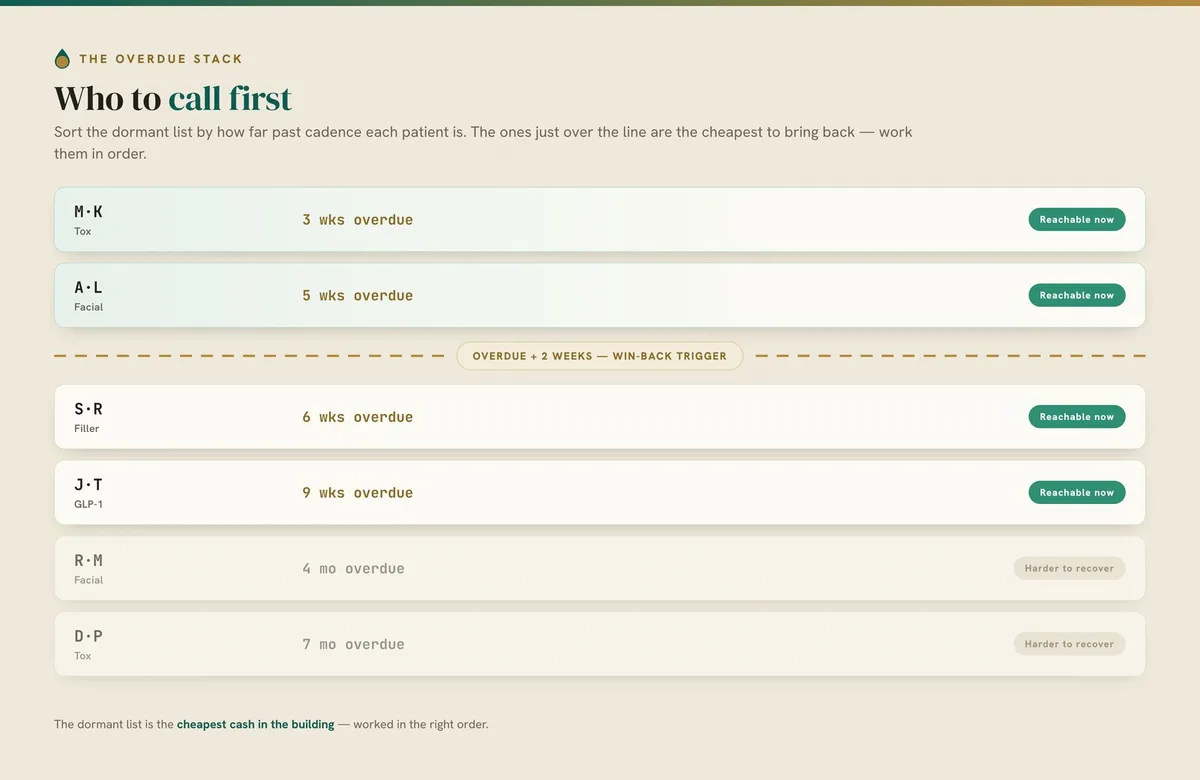
If all you have is a rough “haven’t seen them in a while” list, or nothing, you’re treating a monthly GLP-1 patient, a quarterly tox patient and a patient who comes in twice a year the same way. At 90 days, one is badly overdue and the other isn’t due yet.
If what they hear is the promotion that goes to the whole list, or nothing until they come back on their own, most of them won’t. As I cover in The Reactivation Playbook, the most common reason patients go inactive is that they forgot about you. They didn’t leave angry. They left unattended.
What most practices do, and a better routine
Most practices run a reactivation push once a year, when someone remembers, as a single blast.
A better routine:
- Define “lapsed” by treatment cycle. Around 90 days for monthly programs like GLP-1 or hormones, around six months for quarterly aesthetics.
- Flag patients as they cross that line, continuously, instead of letting them drift for a year.
- Run a short sequence rather than one message: a warm text and email, a follow-up two weeks later, a friendly last note, then a personal call from the provider.
- Make the call. It’s the step most practices skip, and it converts best.
One number to check this week
In your booking system, pull patients whose last visit was 6 to 14 months ago. Group them by their last service. You only need counts.
Then ask one question: when did anyone last contact the people on that list, one to one?
Don’t wait on it. In The 2,000 Names You’re Sitting On I note that patients gone 6 to 12 months reactivate at 15% to 20%, and patients gone 18 months or more drop to 5% to 8%.
Napkin math
Lapsed patients × average annual value of a patient when they were active × 10%
The playbook’s four-step sequence typically recovers 10% to 15% of lapsed patients, so 10% is the low end. Practices that send one message and skip the call often see 3% to 5%, so if you won’t make the calls, use that instead. Either way, it’s an estimate from your own list, not a result.
Or have it installed.
Everything above is yours to build, and plenty of practices do. If you'd rather it was running by the end of the month, this is the install that closes it — fixed price, a named number, and a report at day 60 comparing it against where you started.
Not sure yet
Book a free 15-minute call
We'll talk about this and whether an install is worth it for you
Free · No commitment
Or size it first
Found Money Audit
Your own numbers, across all six areas, ranked by what to fix first
$497
Haven't taken the Free Practice Diagnostic, or want to run it again? Take it now, about 90 seconds →
The other five leaks
A leak is money from patients you already have that slips away without anyone deciding it should.
All six leaks →