The Follow-Up Email That Gets Responses: Three Messages for the Consult That Didn't Book
Most med spas never contact the two-thirds of consults who leave undecided. Three short messages over a week recover an estimated $36,000 a year in first visits at a practice running 600 consults.

Bill Eisenhauer
May 14, 2026 · 8 min read
The follow-up email that gets responses from an undecided consult patient isn’t a sales email. It’s three short messages over a week: one that reminds her why she came in, one that answers the worry she didn’t say out loud, and one that makes booking effortless. At a practice running about 600 consults a year where two-thirds leave undecided, recovering one in five of those is worth roughly $36,000 a year in first visits alone (estimate: 400 × 20% × $450), before any of those patients come back.
At a glance
- Consult close rates typically run 25% to 35%. Practices that follow up with every undecided consult push past 45%, and the best reach into the 60s.
- Most practices send nothing at all to the patient who said “I’ll think about it.” She isn’t a no. She’s a not yet.
- Three messages do most of the work: value at 24 hours, the unspoken objection at 72 hours, and an easy path to book at 7 days.
- About 400 undecided consults × 20% recovered × $450 is roughly $36,000 a year in first visits (estimate), from patients you already paid to bring in.
Key takeaways
- The undecided consult is the cheapest patient you’ll ever win. You already paid for the lead and the chair time. The only thing left is the follow-up.
- Write to her, not to your list. The first sentence should mention what she came in for and what she said she wanted. A message that could go to anyone gets read like an ad.
- Answer the fear before she names it. Med spa hesitation clusters around a few worries: needles, looking overdone, cost and whether it’s worth it. Name the likely one gently and answer it.
- Check this week: pull every consult from last quarter that didn’t book and count the follow-up touches each one got. If most got zero, multiply that count by 20% and your average ticket.
- Take the free diagnostic → It estimates what your consult follow-up gap is costing, in about 90 seconds.
Why do most consult follow-up emails fail?
In The Med Spa Money Map, the example practice, Lumen Aesthetics, logged a little over 150 consults in a quarter. About a third booked a treatment. The other two-thirds said “I’ll think about it” or “let me check my schedule” and were never contacted again. Not once.
That’s the most common failure: no email at all. The second most common is an email that reads like a brochure. It opens with the practice (“We’re a full-service aesthetics practice specializing in natural results”), links a gallery, and closes with “Let us know if you’d like to schedule.” It could have gone to anyone, so she reads it like an ad and archives it.
Three things go wrong in that email:
It’s about the practice, not her. She came in worried about the lines between her eyebrows before her daughter’s wedding. The email talks about your credentials.
It asks her to do the work. “Let us know” means she has to open her calendar, pick a time and reach out. For someone who’s still deciding, that’s too much.
It ignores why she didn’t book. Something stopped her in the consult room. A generic follow-up doesn’t mention it, so the hesitation stays exactly where it was.
This is the consult follow-up leak, and it’s quiet because undecided patients don’t complain or cancel. They just go home.
What does a follow-up email that works look like?
Three messages over about a week. Each one is short and specific to the patient.
Message 1, at about 24 hours: remind her why she came in. Mention the treatment and the goal she described, in her words, and add one useful detail.
Hi Maria, it was lovely meeting you yesterday. You mentioned wanting to look rested for the wedding in October, not “done.” Tox takes about two weeks to settle fully, so anytime in the next month keeps you well ahead of the date.
No ask yet. The message just picks up the conversation where it stopped.
Message 2, at about 72 hours: answer the worry she didn’t say. By now she’s talked herself into a hesitation. The common ones in aesthetics are predictable: nervous about needles, afraid of looking overdone, unsure about cost, not sure it’s worth it. Pick the one her consult notes point to.
A lot of patients tell me their biggest worry is looking overdone. That’s why Dr. Adler starts conservative. We can always add at your two-week check, but we can’t take away.
If cost was the hesitation and you offer a membership, this is where you show how patients spread treatment across the year.
Message 3, at about 7 days: make booking easy, and make no easy too.
I don’t want timing to get in the way. I have Tuesday at 2 or Thursday at 10 next week. Want me to hold one? And if now isn’t the right time, no pressure at all. I’ll check back in a few months.
Two specific times get a faster answer than an open question. The explicit permission to say no lowers the pressure, and people say yes more readily when they feel free to say no.
After three messages, stop the sequence. A patient who doesn’t answer three helpful notes isn’t ready yet. Move her to a slower, longer-term list rather than a fourth nudge.
What is the undecided consult worth?
Here’s the math on Lumen’s numbers. About 600 consults a year, a third booking, leaves about 400 undecided patients. The average ticket for a first treatment runs $300 to $600.
400 undecided consults × 20% recovered × $450 average ticket = $36,000 a year (estimate)
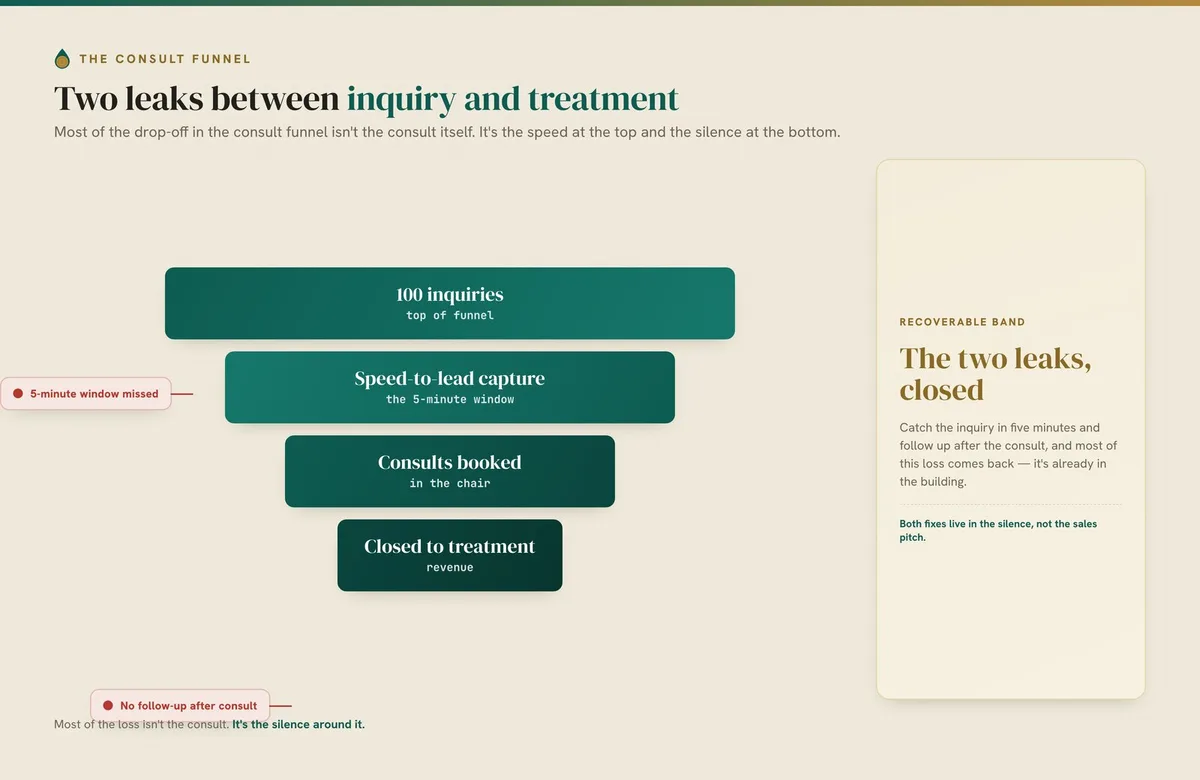
That’s first visits only. Every recovered patient then enters the lifetime-value math: at a conservative $3,000 per patient, 80 recovered patients represent far more than their first ticket. Raise the close rate from the low 30s toward 45% and the figure climbs further. I go through the same gap from the practice’s side in The Follow-Up Gap.
How do you fix it?
Start by hand, with one coordinator and three messages.
1. Write the three messages once. Draft a version of each for your top four treatments: tox, filler, your main device series and your GLP-1 program if you have one. Leave blanks for her name, her goal and the provider. This takes an afternoon.
2. Make “no follow-up” impossible. Every consult that doesn’t book goes on a list the same day, with a named owner at the front desk. The owner sends message 1 the next morning and marks each touch as it goes out. A shared spreadsheet is enough to start.
3. Use the consult notes. Ask providers to write one line at the end of every consult: what she wants and what seemed to hold her back. That line is what makes message 2 land. Without it, the coordinator is guessing.
4. Count bookings, not opens. Track how many undecided consults booked within 30 days of message 3. That’s the number that tells you whether the sequence works.
Two guardrails. If you use before-and-after photos in follow-up, check with your medical director or counsel what you’re allowed to show and claim. And confirm your consent to text or email patients this way is on file before you automate it.
What does AI actually do for consult follow-up?
Scheduling the three messages is ordinary automation. The drip sequence in your booking or email software can fire at 24 hours, 72 hours and 7 days after an unbooked consult. That part isn’t AI, and for many practices it closes most of the gap.
The judgment is in message 2. A canned template can’t read this patient’s consult notes and write the line that names her specific worry in the words her injector used. Doing that for every undecided consult, at a few hundred a year, is drafting against context that a coordinator can’t sustain. The other seam is spotting warmth: the patient who opened message 1 three times and clicked the booking link without finishing is worth a personal call today. AI doesn’t close the consult. It makes sure the follow-up sounds like it came from someone who was in the room.
FAQ
How soon should a med spa follow up after a consult?
Send the first message about 24 hours after the consult, while the conversation is fresh. Follow with an objection-focused note at about 72 hours and an easy booking offer at about 7 days. Most practices send nothing, so even a simple version of this sequence stands out.
What should a consult follow-up email say?
Mention what the patient came in for and the goal she described, answer the worry that most likely held her back, and offer two specific times to book. Keep each message to a few sentences. Avoid generic lines like “just following up” and practice descriptions she’s already heard.
What is a good consult conversion rate for a med spa?
Typical consult-to-treatment close rates run 25% to 35%. Practices that follow up with every undecided consult reach 45% or higher, and the best reach into the 60s. The gap between those numbers is mostly follow-up that never happened.
How many follow-up messages are too many?
Three over about a week is enough for the first sequence. After that, move the patient to a slower, longer-term list, such as your newsletter, rather than sending a fourth nudge. Offer an explicit way to say “not now” in the last message.
Should the follow-up include a discount?
Usually not. A discount teaches patients to wait for one and cuts margin on patients who would have booked at full price. Answer the real hesitation instead, and if cost is the concern, show how a membership or treatment plan makes it predictable.
A note on these figures: consult close rates of 25–35% (typical) and 45%+ (when worked) are industry ranges cited in The Med Spa Money Map. Lumen Aesthetics is the book’s example practice, and the $36,000 uses its numbers with a 20% recovery assumption. The sample messages are illustrative. All dollar figures are estimates; count your own undecided consults in your PMS before relying on them. Chapter 5 of The Med Spa Money Map covers this leak in full.
Written by Bill Eisenhauer, Founder of Alchemy Inside.
Revenue & Growth
How much revenue is slipping through your follow-up gaps?
This article explored one category. The free diagnostic scores all six — and gives you a dollar estimate in 90 seconds.
Take the Free Diagnostic